The Economics of the AI Transition
IX. Endgame
Romer loops, institutional resilience, Danish policy, and the open questions.
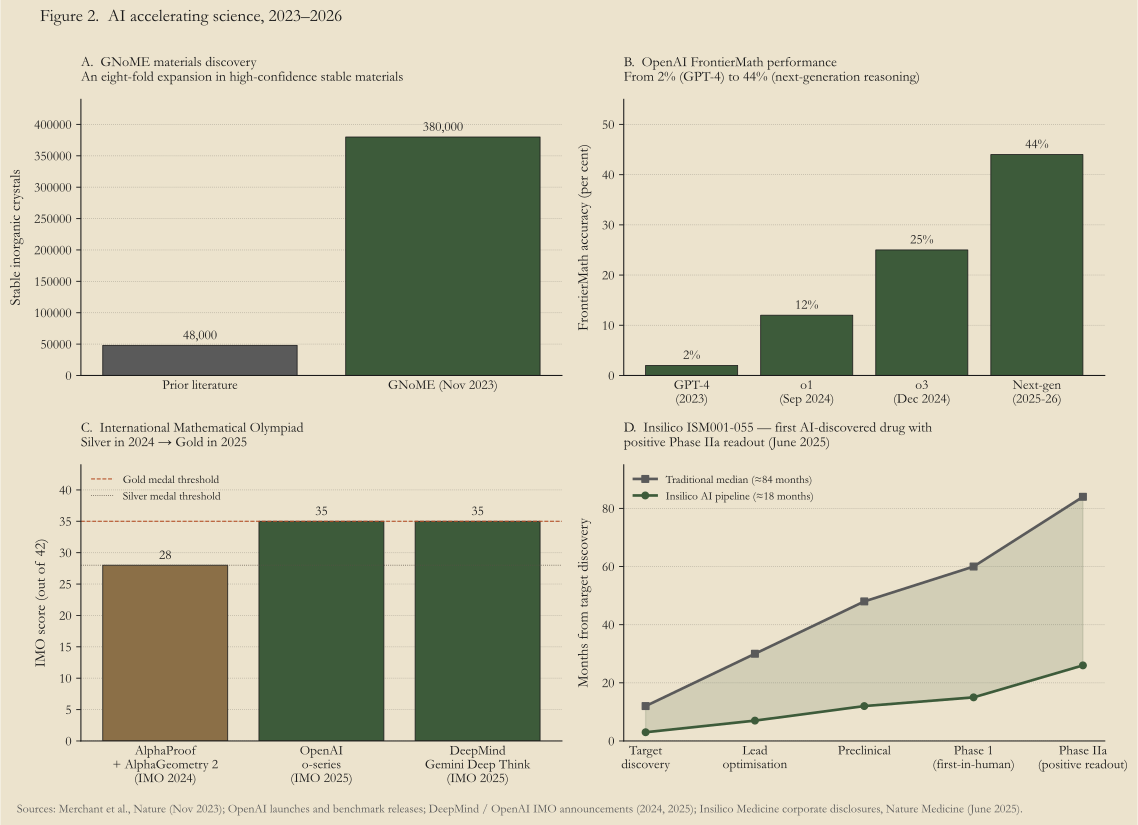
In July 2025 two of the world’s largest AI laboratories scored 35 out of 42 at the International Mathematical Olympiad. OpenAI’s reasoning model and Google DeepMind’s Gemini Deep Think each cleared the gold-medal threshold; DeepMind’s AlphaGeometry 2, a year earlier, had solved one of the geometry problems at IMO 2024 in nineteen seconds.1 The mathematics is not domesticated economic statistics. It is the closest test we have of whether the production function for ideas — the load-bearing input in Romer’s 1990 endogenous-growth model — has just changed shape.2
This is the question the closing chapter has to take seriously. If AI agents can generate and recombine ideas at a rate that compounds on itself, then the rest of the essay’s arithmetic — the Baumol window, the rent capture, the labour share — runs against a backdrop in which the rate of idea creation is no longer set by the size of the researcher population. If it cannot, the rest of the arithmetic runs against a backdrop of bottlenecks the AI hype has not yet absorbed. Both possibilities live inside the empirical record of the past twenty-four months.Start with the optimistic case. The endogenous-growth literature since Romer 1990 has treated ideas as non-rival, partially excludable, and produced by researchers whose number grows at roughly the rate of population.2 Charles Jones’s 1995 semi-endogenous response showed that the Romer scale effect does not survive the time-series data — long-run growth is anchored to population growth, not policy effort.3 Aghion, Jones, and Jones’s 2017 NBER paper formalised the AI extension: if AI can substitute for the labour input into idea production, the size of the researcher population stops binding.4 Trammell and Korinek’s 2023 NBER review, forthcoming in the Annual Review of Economics, lays out the formal taxonomy: under returns-to-scale strong enough in idea production, AI yields explosive growth; under weaker assumptions, it yields a finite boost.5 Aschenbrenner’s Situational Awareness is the rhetorical maximum of the case: “hundreds of millions of AGIs” automating AI research, “compressing a decade of algorithmic progress into one year.”6
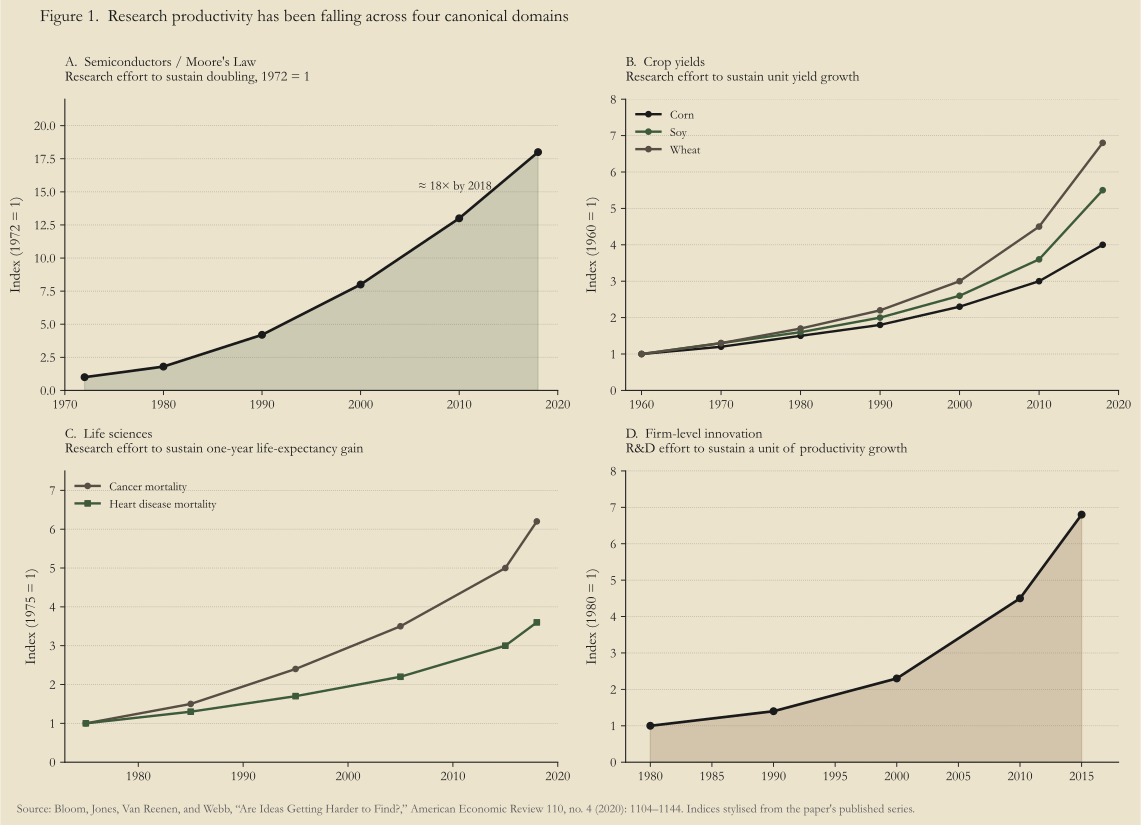
The pessimistic case is empirical, not theoretical. Bloom, Jones, Van Reenen, and Webb’s 2020 American Economic Review paper measured research productivity across four domains — semiconductors, agricultural yields, life sciences, and firm-level innovation — and found a consistent, large decline. The effective number of researchers required to sustain Moore’s Law doubling is roughly eighteen times larger today than in the early 1970s. Aggregate research productivity in the US falls at approximately 5 per cent per year; ideas, in the empirical sense the literature can measure, roughly halve every thirteen years.7 The Bloom-Jones counter to the Romer-loop optimism is not that more researchers do not help. It is that more researchers are needed at an accelerating rate to keep producing the same ideas — a treadmill that AI must outrun before the loop goes vertical.
The empirical evidence from the past two years sits between the two cases. DeepMind’s GNoME predicted 2.2 million stable crystalline materials, of which 380,000 were high-confidence — by one reading, “eight hundred years of accumulated knowledge” produced in a single training run.8 Insilico Medicine’s ISM001-055, an AI-designed inhibitor for idiopathic pulmonary fibrosis, posted a positive Phase IIa readout in June 2025 — the first AI-discovered drug to show efficacy in humans.9 OpenAI’s o3 jumped FrontierMath performance from 2 to 25 per cent in a single model release.10 DeepMind’s AlphaProof and AlphaGeometry 2 won silver at IMO 2024; OpenAI and DeepMind both won gold at IMO 2025.1 Sakana AI’s AI Scientist v2 produced a paper that was accepted at an ICLR workshop through peer review with no human edits, at roughly fifteen dollars of inference cost per paper.11
These are real results. They are also concentrated in domains where the input is structured — mathematics, materials, protein folding, code — and where verification is cheap. The Acemoglu reply from chapter four still applies. Hulten’s theorem caps the macro TFP gain at the task-share times the cost-saving; the Acemoglu 2024 paper bounds AI’s cumulative ten-year contribution at no more than 0.66 per cent of total factor productivity, and possibly 0.53 per cent if harder-to-learn tasks dominate the wave that follows.12 Romer’s loop, formally, is not falsified by gold medals at the IMO. The empirical record will be made by the labour-demand decomposition that has not yet been written, and by the productivity statistics that have not yet moved.
The physical-world counter is older and harder to dismiss. Vaclav Smil has spent four decades documenting that energy and manufacturing transitions take fifty to eighty years, not because the engineering is hard but because the supply chains, fabrication capacity, and competitive markets that absorb them are slow.13 Nicholas Crafts’s 2004 Economic Journal paper found that steam’s peak contribution to British TFP arrived roughly a hundred years after Watt’s separate condenser.14 The MIT Technology Review reported in March 2025 that more than 500 AI data centre projects had been announced in China since 2023, with up to 80 per cent of completed capacity sitting idle in the months after DeepSeek’s R1 release.15 The Solow overbuild question — whether AI capex resembles Chinese infrastructure overbuild more than it resembles electrification — is unresolved in the formal economics literature but is no longer a thought experiment.
Inside that uncertainty sits the Danish question. The Danish welfare state runs through the reguleringsordningen — the indexation rule that ties public-sector wages to the private sector with a two-year lag.16 In April 2025 the mechanism delivered a negative adjustment of 0.78 per cent against an expected positive 0.04, leaving Danish public employees with a 0.41 per cent rise; the formula was rewritten in November 2025.17 The institutional event is the chapter three thesis arriving in the wage tables. Private wages have run ahead, AI has begun showing up in private-sector productivity, and the public sector has only just registered the gap. The next round of OK negotiations sits on top of an SOSU shortfall the Finance Ministry projects at twenty thousand full-time-equivalents by 2030 across the social-and-health-care and pædagog professions combined.18
In December 2025 the government, Kommunernes Landsforening, and Danske Regioner signed a storskalaprojekter med kunstig intelligens agreement that allocates DKK 266.7 million across three programmes — speech-to-text journalisation, citizen-facing digital assistants, caseworker assistants. The stated target is thirty thousand full-time-equivalents freed by 2035, with a “significant portion” by 2030.19 Mette Frederiksen had told DR the previous March that the public sector should be verdensførende in the use of artificial intelligence.20 DA and BCG estimate, in an August 2024 brief, that generative AI could free six thousand Danish public-sector full-time-equivalents per year through 2040, totalling 88,000 to 96,000 FTEs and DKK 48 to 55 billion in annual productivity gain.21
The two numbers — six thousand FTEs freed per year against twenty thousand FTEs short by 2030 — are the chapter’s central arithmetic. If the DA-BCG projection lands and the storskala programmes deliver, the public-sector AI productivity gain offsets enough of the wage spike to keep the fiscal arithmetic survivable. If the projection does not land and the wage curve runs ahead, the holdbarhedsindikator falls further than its 2025 revision to plus one per cent of GDP, and Denmark either taxes more or borrows more inside the window.22 The institutional architecture for the alternative is on the books. ATP administers approximately DKK 925 billion at year-end 2025 in tripartite governance; Lønmodtagernes Dyrtidsfond sits in legacy reserve; the folkepension doctrinally accepts universal-residence redistribution as the welfare-state’s anchor.23 What does not exist is the political technology to redirect those instruments toward AI-rent capture before the rent capture has matured. Christiansborg has not yet had the conversation.What the Danish policy package would actually contain
The shape of the package the chapter is pointing at is not original, but it is concrete: a wealth- or capital-rent tax calibrated to AI-firm equity gains rather than realised income; a redirection of ATP’s investment mandate to take a larger position in the AI substrate (compute, energy, materials); a sovereign-wealth structure modelled on Norway’s Statens pensjonsfond utland but capitalised by a windfall claim on hyperscaler operations in Denmark and on the Danish data commons that has trained the foundation models; a Lønstrukturkomité-style review of the public-sector wage indexation that survives the Baumol window; and a sustained investment in AMU vocational training and professionshøjskole AI integration for the cohorts the Canaries paper identified as most exposed. None of these is politically easy. Each rests on the institutional capacity Denmark already has, and on the policy will it has not yet shown.
What would change the thesis. Three open questions carry through to the next four years.
The first is reinstatement. The Acemoglu-Restrepo-style task-content decomposition of US labour-demand growth in the post-2022 AI era has not been written. When it is, the result will adjudicate the disagreement between Acemoglu’s reading (the trough is the whole story) and Brynjolfsson’s (the J bends back). The watch metric is the BLS labour-share series, the Stanford Digital Economy Lab’s updates to the Canaries paper, and the Anthropic Economic Index augmentation-to-automation split.
The second is humanoid manufacturing scale. The Baumol window from chapter three closes when robotics catches the physical economy. Unitree shipped roughly 5,500 humanoid units in 2025; Tesla, Figure, 1X, and Boston Dynamics have collectively shipped fewer than that in commercial deployment.24 Goldman Sachs projects 1.4 million units per year by 2035; Bank of America projects 10 million; Citi projects 13.25 The spread is two orders of magnitude. The watch metric is the verified-deliveries column of those forecasts, year by year, and the Optimus V3 production line if it appears.
The third is rent capture. Open-weight models lag the closed frontier by roughly three months on the Epoch Capabilities Index and have closed thirteen index points on the Artificial Analysis Intelligence Index in the past twelve months.26 If the gap closes further, the producer rent that has accumulated to NVIDIA, the hyperscalers, and the frontier labs is eroded by the diffusion the chapter five argument predicted would not save us. If the gap reopens or stalls, the rent capture compounds and the policy fork from chapter seven becomes more urgent. The watch metric is the Epoch series, the inference price-per-token curve, the FTC / EU AI Act enforcement record after 2 August 2026, and — the macro counterpart to all of them — the gap between real GDP per capita growth and real wage growth that chapter V’s consumption-channel argument predicts will widen.
The thesis is falsifiable on two counts, mirroring the structure of the previous essay. On the Baumol window: global humanoid shipments exceed one million units annually before 2030 and US public-sector real unit-labour-cost falls year-on-year by 2028 — closing the gap between tsoftware and trobotics before fiscal stress materialises in the welfare states most exposed. On the rents: open-weight models match closed-frontier on Humanity’s Last Exam within twelve months and US labour share rises three percentage points by 2030 — falsifying both producer-rent capture and labour-displacement at once. Neither falsification is on the trend curve as of May 2026.The substrate is being locked down now. The Baumol window opens before the productivity that closes it arrives in the statistics. The capital that captures the rent in between owes nothing to the wage base under the income tax. Denmark has the institutional architecture to own enough of the AI economy to fund its own welfare bill in 2035. The chapters before this one are the argument for why that architecture should be used. The question that remains is whether the policy class writes the policy in time.
Footnotes
-
International Mathematical Olympiad 2025 results: OpenAI o-series and Google DeepMind Gemini Deep Think each scored 35 of 42, gold-medal threshold. DeepMind announcement, 2025. AlphaProof and AlphaGeometry 2 at IMO 2024 (silver, 28 of 42): DeepMind blog and Nature (2025): https://www.nature.com/articles/s41586-025-09833-y. ↩ ↩2
-
Paul M. Romer, “Endogenous Technological Change,” Journal of Political Economy 98, no. 5, pt. 2 (1990): S71–S102 — already cited in chapter V; the non-rivalry framework is the substrate of the Romer-loop argument. ↩ ↩2
-
Charles I. Jones, “R&D-Based Models of Economic Growth,” Journal of Political Economy 103, no. 4 (1995): 759–784. Charles I. Jones, “The End of Economic Growth? Unintended Consequences of a Declining Population,” American Economic Review 112, no. 11 (2022): 3489–3527. ↩
-
Philippe Aghion, Benjamin Jones, and Charles I. Jones, “Artificial Intelligence and Economic Growth,” NBER Working Paper 23928, 2017. ↩
-
Philip Trammell and Anton Korinek, “Economic Growth under Transformative AI,” NBER Working Paper 31815, 2023; forthcoming Annual Review of Economics, September 2025. ↩
-
Leopold Aschenbrenner, Situational Awareness: The Decade Ahead, June 2024 — the intelligence-explosion section, with the “100,000× research workforce” framing. ↩
-
Nicholas Bloom, Charles I. Jones, John Van Reenen, and Michael Webb, “Are Ideas Getting Harder to Find?,” American Economic Review 110, no. 4 (2020): 1104–1144. Headline finding: the effective number of researchers required to sustain Moore’s Law doubling is roughly 18 times larger today than in the early 1970s; aggregate research productivity falls at approximately 5 per cent per year across the four measured domains. ↩
-
Amil Merchant et al., “Scaling deep learning for materials discovery,” Nature 624 (November 2023): 80–85. ↩
-
Insilico Medicine, ISM001-055 (rentosertib) — first-in-class TNIK inhibitor for idiopathic pulmonary fibrosis. Positive Phase IIa readout, June 2025, published in Nature Medicine: PubMed; company disclosure: insilico.com/phase1. ↩
-
OpenAI o3 model launch and FrontierMath benchmark: OpenAI; FrontierMath performance jumped from approximately 2 per cent (GPT-4 baseline) to 25 per cent with o3. ↩
-
Sakana AI, The AI Scientist v2, April 2025; the v2 system produced the first ICLR-workshop paper accepted via peer review with no human edits at approximately fifteen dollars of inference cost per paper. ↩
-
Daron Acemoglu, “The Simple Macroeconomics of AI,” NBER Working Paper 32487, 2024; published in Economic Policy 40, no. 121 (2025): 13–58. ↩
-
Vaclav Smil, Energy Transitions: Global and National Perspectives, 2nd ed. (Praeger, 2017); Grand Transitions (Oxford University Press, 2021). ↩
-
Nicholas Crafts, “Steam as a General Purpose Technology: A Growth Accounting Perspective,” Economic Journal 114, no. 495 (2004): 338–351. ↩
-
Caiwei Chen, “China built hundreds of AI data centers… Now many stand unused,” MIT Technology Review, March 2025. ↩
-
The reguleringsordning mechanics: Forhandlingsfællesskabet. ↩
-
April 2025 reguleringsordningen adjustment of −0.78 per cent and the November 2025 mechanism rewrite: HK; CS. ↩
-
Finansministeriet long-run projection of 20,000-FTE shortfall across SOSU and pædagog professions by 2030: reported via Altinget. ↩
-
Digitaliseringsministeriet, “Aftale om tre storskalaprojekter med kunstig intelligens i den offentlige sektor,” December 2025; coverage Altinget and DR. Target: thirty thousand FTEs freed by 2035; DKK 266.7 million across three programmes. ↩
-
Mette Frederiksen on Danish public-sector AI ambition, March 2025: DR. ↩
-
Dansk Arbejdsgiverforening and Boston Consulting Group, GenAI: Significant Potential for the Danish Public Sector in 2040, August 2024 — already cited in chapter VI. ↩
-
Det Økonomiske Råd, Dansk Økonomi, efterår 2025; the holdbarhedsindikator was revised down from plus 1.5 per cent of GDP in autumn 2024 to plus 1.0 per cent in autumn 2025 — already cited in chapter III. ↩
-
ATP year-end 2025 AUM and tripartite governance: Top1000Funds; LD Fonde, Årsrapport 2024 — already cited in chapter VII. ↩
-
Unitree H1 and G1 verified 2025 shipments and the Western humanoid ramp: aggregated by Humanoids Daily — already cited in chapter III. ↩
-
Bank-research humanoid forecasts compared: Goldman Sachs Research; Bank of America Global Research Humanoid Robots 101 (April 2025); Citi humanoid-sector report — already cited in chapter III. ↩
-
Epoch AI, “Open-weight models lag state-of-the-art by around three months on average,” 2026 — already cited in chapter V. ↩