The Economics of the AI Transition
VII. Who Owns the Machine
Capital rents, perfect price discrimination, and the policy surface that survives the libertarian objection.
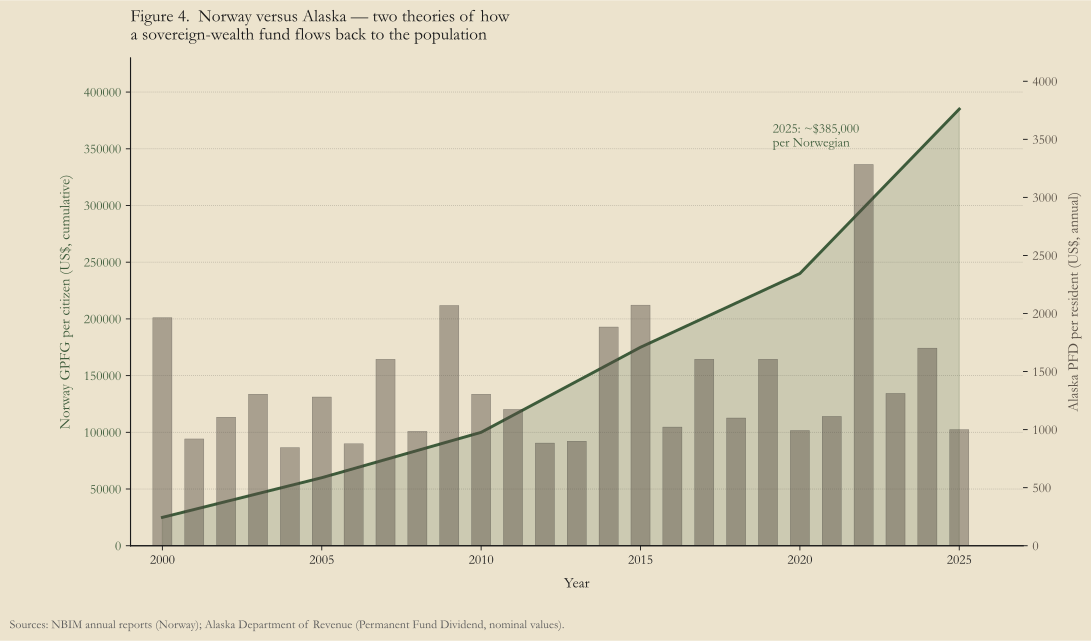
In December 2025 Norway’s Statens pensjonsfond utland passed two trillion US dollars in assets under management.1 Divided by the population of Norway, the fund’s holdings work out to roughly $385,000 in foreign equities, bonds, and real estate for every citizen — a stake in the world economy that every Norwegian newborn inherits before drawing first breath.1 A Danish newborn the same week inherited nothing comparable. The Danish equivalents are real but smaller, more sectoral, and structured differently. The Arbejdsmarkedets Tillægspension administers roughly DKK 925 billion of pension assets; Lønmodtagernes Dyrtidsfond holds a legacy DKK 24 billion in a fund frozen since 1980; the broader institutional landscape is built around income redistribution rather than asset redistribution.2
This is the chapter on the difference between the two. The argument of the preceding chapters has been that AI is producing rents at the substrate, the model, and the application layers; that those rents are accumulating in the equity values of a small set of firms; that labour share is falling in the US and stagnating in the EU; and that orthodox income-tax-funded welfare cannot follow the rent if the rent is structurally not in wages. What follows is the question of what the policy surface against that pattern looks like — and what its political-philosophy limits are.
Piketty’s Capital in the Twenty-First Century framed the long-run argument as an inequality between r — the return to capital, historically around four to five per cent — and g, the rate of economic growth, historically one to two per cent.3 If r exceeds g, the wealth-to-income ratio rises and wealth concentrates over time absent fiscal intervention. The Pikettian generalisation has been contested. Matt Rognlie’s 2015 Brookings paper showed that the entire rise in the net capital share in the US since 1948 came from housing — non-housing net capital share was roughly flat.4 Acemoglu and Robinson, in a 2015 Journal of Economic Perspectives, argue that institutions dominate r minus g in any panel that tries to identify the effect.5
The AI-specific argument does not rest on the original Pikettian mechanic. It rests on what chapter five already established: AI capital is non-rival but excludable, with near-zero marginal cost of replication.6 When the firm holding the model can charge for access without congestion losses, the standard “diminishing returns to capital” pressure on r is weak. The rent persists; the firm captures it. Anton Korinek and Donghyun Suh’s 2024 NBER paper formalises the implication: under bounded task complexity, full automation collapses wages, and the rents accrue to capital owners in proportion to pre-existing wealth.7 Daniele Maresca’s February 2025 working paper calibrates pre-AI real rates at 10 to 16 per cent against a baseline of about 3, on the assumption that markets price the prospective income from a fixed factor against a vanishing labour share.8 An IMF working paper in April 2025 ran a DSGE in the same direction.9
The data has already started to track what the models predict. The Federal Reserve’s Distributional Financial Accounts show the top one per cent of US households holding 31 per cent of total wealth and 50.2 per cent of corporate equities and mutual-fund shares in Q3 2025.10 The Forbes 400 list for 2025 reports the aggregate net worth of the four hundred richest Americans at $6.6 trillion, up $1.2 trillion year-on-year; the entry threshold is $3.8 billion.11 UBS’s Billionaire Ambitions Report 2025 puts global billionaire wealth at $15.8 trillion — a record — with tech billionaire wealth up 23.8 per cent in a year to $3 trillion; six US tech billionaires alone added $171 billion in 2025.12
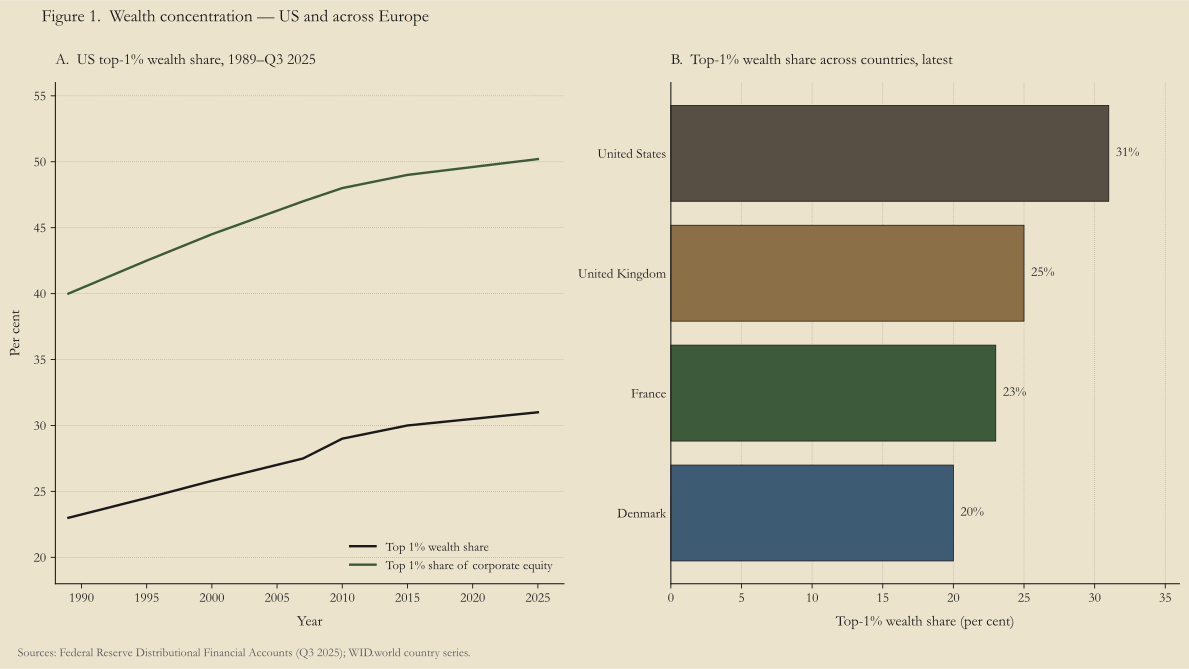
The Danish distribution sits in the European pattern. WID.world series put the Danish top-one-per-cent wealth share at roughly 20 per cent, against approximately 31 per cent in the United States. The Danish administrative wealth panel that Jakobsen, Jakobsen, Kleven, and Zucman analysed in their 2020 Quarterly Journal of Economics paper documented top-ten-per-cent wealth shares between 50 and 80 per cent depending on definition.13 Denmark is less unequal than the United States and more equal than the EU average. That is the starting condition. Whether it survives the AI rent-capture wave is the chapter’s open question.
The rent-capture story so far has been about the producer side — capital, equity, the substrate. There is a parallel story on the consumer side that the economics literature has been slow to name. Arthur Pigou’s 1920 textbook taxonomy of price discrimination — first-degree (charging each consumer their reservation price), second-degree (by quantity), third-degree (by group) — has carried economics for a century with first-degree treated as a thought experiment. The firm could not, in practice, know each consumer’s willingness to pay.14
Hal Varian’s 1996 First Monday essay sharpened the welfare implications: first-degree price discrimination is allocatively efficient — it produces no deadweight loss, because the firm sells to every consumer who values the good above marginal cost — but it transfers the entire consumer surplus to the producer.15 The classical objection is distributional, not Pareto. The classical infeasibility, however, has now substantially relaxed. AI inference at near-zero marginal cost lets the firm infer willingness to pay from the same data infrastructure already used for ad targeting.
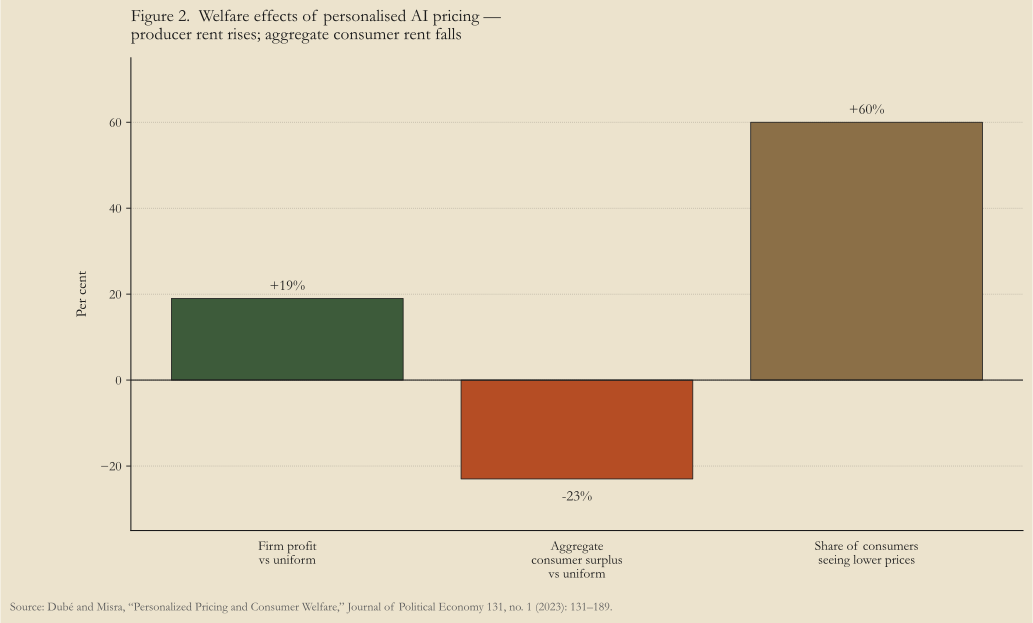
Documented practice in 2024 and 2025 confirms the trajectory. In November 2024 Delta Air Lines’s president Glen Hauenstein told an investor day that the airline was working with the AI vendor Fetcherr to replace its price grid with per-individual pricing; the stated target was 20 per cent of fares on AI-personalised pricing by the end of 2025, with 3 per cent already deployed.16 In February 2024 Wendy’s announced and then walked back a dynamic-pricing pilot after public backlash; the walk-back is this chapter’s Klarna moment on the consumer side — public consciousness arrived faster than the deployment.17 In November 2025 the US Department of Justice settled with RealPage over the YieldStar algorithm, which had coordinated rental pricing across millions of US apartments for a decade.18 Dubé and Misra’s 2023 Journal of Political Economy paper measured the welfare effects directly: personalised pricing raised firm profit 19 per cent over optimal uniform pricing and 86 per cent over the status quo; aggregate consumer surplus fell 23 per cent against the uniform benchmark.19
This is the chapter where the political-philosophy register has to be engaged, because the policy surface against that compound effect runs into the libertarian foundations of property law. John Locke’s Two Treatises of Government (1689) grounds property in labour-mixing: by applying her labour to nature, the individual extends self-ownership over the resulting object. The proviso — “enough, and as good left in common for others” — limits the claim.20 Robert Nozick’s 1974 Anarchy, State, and Utopia extends the Lockean intuition into entitlement theory: a just distribution can only result from just acquisition and just transfer; any state-imposed patterned distribution must violate liberty.21 The Wilt Chamberlain argument is the standard illustration. Any patterned just distribution, once you allow voluntary transfers, produces a new distribution that violates the pattern. Patterned redistribution requires continual interference; the libertarian conclusion is that the pattern cannot stand.
The AI transition complicates the Lockean foundation in a way that is now legally documented. Stable Diffusion and the foundation models that followed were trained on corpora scraped from human-authored work — text, images, code. When Getty Images sued Stability AI in the English High Court, the November 2025 judgment held that Stability had not infringed Getty’s copyrights because the model “does not store the training data itself”.22 The labour of the original photographers has been mixed into something that no longer legally contains it. The labour-mixing claim that grounds property in the Lockean tradition has been technically un-mixed by the architecture of generative AI. The proviso fails in a more literal sense too: if “enough, and as good” cannot be left because the training has already enclosed the data commons, the foundation under the capital that emerged from that enclosure is weaker than the libertarian framework allows.The standard egalitarian rejoinders are familiar — Rawls’s difference principle, Sen’s capability approach, Elizabeth Anderson’s relational equality argument in Ethics (1999).23 The more interesting closure for this chapter comes from inside the libertarian frame itself. The left-libertarian tradition — Hillel Steiner, Michael Otsuka, Philippe van Parijs — accepts full self-ownership and derives an egalitarian claim on the rents of natural resources and commons.24 If AI capital is, partly, the rent on an enclosed data commons, the left-libertarian frame already supports the redistribution case the Nozickian frame opposes.
Where the libertarian objection actually binds
The libertarian objection to AI-rent redistribution sits in two places. First, in the historical justice claim: capital was accumulated through voluntary transfers, and any forced redistribution violates the rights that grounded the accumulation. The Lockean labour-mixing premise carries this claim. Second, in the practical objection: even if the historical claim is weak, redistribution at sovereign-fund scale requires institutional capacity that may produce worse outcomes than the inequality it corrects. The first objection is what Getty v. Stability AI loosens. The second objection is what Norway’s Government Pension Fund Global — operating at arm’s length from the Finance Ministry for thirty-five years, with public reporting and a 3 per cent fiscal-rule withdrawal cap — has answered empirically. Both objections matter; neither is dispositive against carefully designed redistribution.
The policy instruments range from the orthodox to the speculative. Anthony Atkinson’s 2015 Inequality: What Can Be Done? proposed two relevant moves: a Public Investment Authority running a sovereign-wealth fund on behalf of the state, and a capital endowment paid at the age of majority.25 Thomas Piketty’s 2020 Capital and Ideology sharpened the second proposal — €120,000 at age 25 for every French citizen, financed by progressive wealth and inheritance taxes totalling roughly five per cent of GDP.26 Sam Altman’s 2021 essay Moore’s Law for Everything proposed an American Equity Fund: a 2.5 per cent annual tax on the market capitalisation of companies above a threshold, paid in shares, plus a 2.5 per cent land-value tax, distributed to every adult citizen.27 Worldcoin — Tools for Humanity’s biometric-identifier project — is the actual operationalisation attempt, with roughly 12 million biometric enrolments by mid-2025 and average payouts of about $50 per user.28 The arithmetic is far short of UBI. The operationalisation is the point.
Sovereign-wealth-fund operationalisation has more empirical traction. Norway’s Government Pension Fund Global, established in 1990 to absorb oil revenue that would otherwise have inflated the krone, is the cleanest working model: roughly two trillion dollars in AUM at year-end 2025, governed by Norges Bank Investment Management at arm’s length from the Finance Ministry, with a fiscal rule capping annual withdrawals at three per cent of expected real return since 2017.29 Alaska’s Permanent Fund Dividend distributed $1,000 per resident in 2025 — the smallest dividend in roughly a decade, after political squeeze on the legislature.30 The SWF route is not automatic; the political technology has to be designed for durability against changing legislatures.
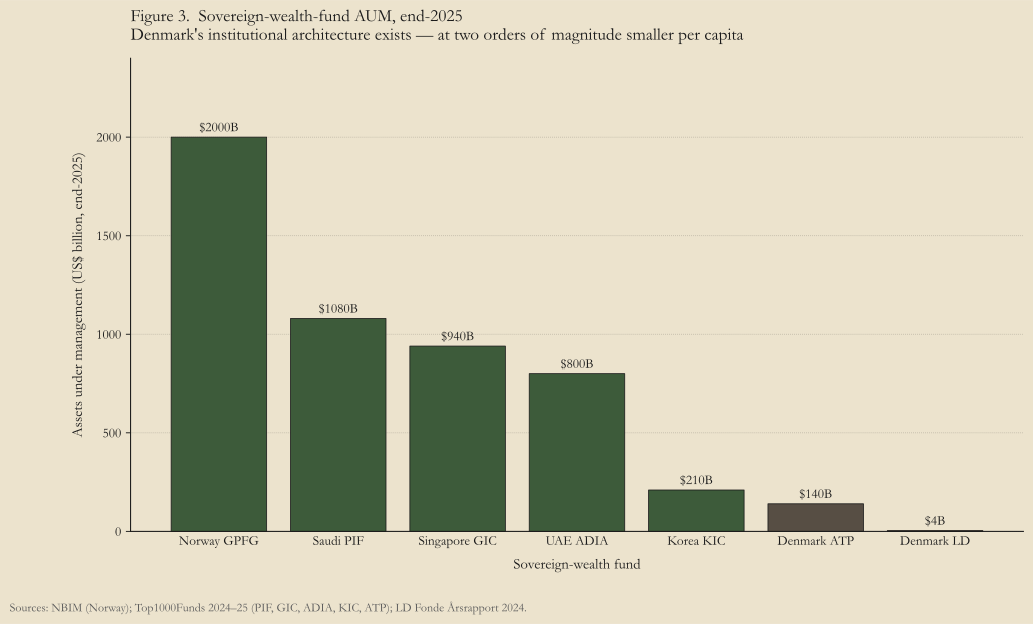
Denmark has the institutional architecture for capital-share redistribution already on its books. ATP administers roughly DKK 925 billion of pension assets at year-end 2025 for approximately five million members, with tripartite governance through a Folketing-appointed Repræsentantskab and statutory autonomy within its mandate.31 Folkepension, the universal residence-based old-age benefit, is the doctrinal counter-template to means-testing in the broader Danish welfare-state design. The system is built on near-universal compulsory contribution and universal benefit — the structural cousin of a sovereign-wealth fund, financed through wages rather than through extraction of capital rents.
The pivot the chapter is naming is from wage-financed redistribution to capital-financed redistribution. The Danish welfare state has not yet made that pivot. The Norwegian one already has. If the Baumol-window thesis from chapter three holds and the rent-capture thesis from chapter five holds, the wage base under the income tax does not grow fast enough to fund the public services whose costs are rising fastest. Capital-share redistribution at the ATP scale, restructured to capture the AI rent as it accrues, is the institutional template Denmark already has the legal and administrative architecture for. The question is whether it gets used.The policy surface is real. The political surface is uncertain. The Lockean foundation under the libertarian objection is weaker than the libertarian objection allows. The institutional architecture in Denmark already exists, and the political technology to point it at the rent does not. The reader who has read this chapter is now waiting for that technology, or building around its absence.
Footnotes
-
Norges Bank Investment Management, Annual Return 2025. End-2025 AUM in NOK 21.27 trillion, approximately $2.0 trillion at the year-end exchange rate; reported 2025 return of $247 billion. Per-capita figure derived against Norwegian population of approximately 5.55 million (Statistisk sentralbyrå). ↩ ↩2
-
ATP year-end 2025 AUM from Top1000Funds, “Government of Singapore Investment Corporation (GIC) — peers,” 2024–25 update; LD Fonde, Årsrapport 2024. ↩
-
Thomas Piketty, Capital in the Twenty-First Century (Belknap Press / Harvard University Press, 2014). ↩
-
Matt Rognlie, “Deciphering the Fall and Rise in the Net Capital Share,” Brookings Papers on Economic Activity, Spring 2015. ↩
-
Daron Acemoglu and James A. Robinson, “The Rise and Decline of General Laws of Capitalism,” Journal of Economic Perspectives 29, no. 1 (2015): 3–28. ↩
-
Paul M. Romer, “Endogenous Technological Change,” Journal of Political Economy 98, no. 5, pt. 2 (1990): S71–S102 — already cited in chapter V; the non-rivalry argument is the substrate of the AI-r-greater-than-g claim that follows. ↩
-
Anton Korinek and Donghyun Suh, “Scenarios for the Transition to AGI,” NBER Working Paper 32255, 2024. ↩
-
Daniele Maresca, “Strategic Wealth Accumulation Under Transformative AI Expectations,” arXiv:2502.11264, February 2025. ↩
-
International Monetary Fund, AI Adoption and Inequality, IMF Working Paper WP/25/68, April 2025. ↩
-
Federal Reserve, Distributional Financial Accounts, Q3 2025. Top-one-per-cent wealth share 31.0 per cent; top-one-per-cent share of corporate equities and mutual-fund shares 50.2 per cent. ↩
-
Forbes 400 (2025). Aggregate $6.6 trillion; entry threshold $3.8 billion. ↩
-
UBS, Billionaire Ambitions Report 2025, December 2025. ↩
-
Katrine Jakobsen, Kristian Jakobsen, Henrik Kleven, and Gabriel Zucman, “Wealth Taxation and Wealth Accumulation: Theory and Evidence from Denmark,” Quarterly Journal of Economics 135, no. 1 (2020): 329–388. Danish top-one-per-cent wealth share from WID.world country series. ↩
-
A. C. Pigou, The Economics of Welfare (Macmillan, 1920). ↩
-
Hal R. Varian, “Differential Pricing and Efficiency,” First Monday 1, no. 2 (1996); Varian, “Price Discrimination,” in Handbook of Industrial Organization, vol. 1, ch. 10 (North-Holland, 1989). ↩
-
Glen Hauenstein, Delta Air Lines investor-day remarks, November 2024; reporting via Fortune, July 2025. Target: 20 per cent of fares on AI-personalised pricing by end-2025; 3 per cent already deployed. ↩
-
Wendy’s dynamic-pricing announcement and walk-back, February 2024: NPR; Bloomberg. ↩
-
US Department of Justice proposed settlement with RealPage over the YieldStar algorithm, November 2025: ProPublica. ↩
-
Jean-Pierre Dubé and Sanjog Misra, “Personalized Pricing and Consumer Welfare,” Journal of Political Economy 131, no. 1 (2023): 131–189. Profit rises 19 per cent over optimal uniform pricing; consumer surplus falls 23 per cent against the uniform benchmark; roughly 60 per cent of consumers see lower prices, the remainder higher. ↩
-
John Locke, Two Treatises of Government (1689), Second Treatise, Chapter V, “Of Property.” ↩
-
Robert Nozick, Anarchy, State, and Utopia (Basic Books, 1974), pp. 160–164 on the Wilt Chamberlain argument. ↩
-
Getty Images (US) Inc & Ors v Stability AI Ltd, English High Court, judgment 4 November 2025. Legal analysis: Latham & Watkins. The court held that Stability did not infringe Getty’s copyrights because the model “does not store the training data itself” — a finding that, for Lockean property theory, dissolves the labour-mixing claim rather than vindicating Stability’s process. ↩
-
John Rawls, A Theory of Justice (Harvard University Press, 1971); Amartya Sen, The Idea of Justice (Harvard University Press, 2009); Elizabeth Anderson, “What Is the Point of Equality?,” Ethics 109, no. 2 (1999): 287–337. ↩
-
Hillel Steiner, An Essay on Rights (Blackwell, 1994); Michael Otsuka, Libertarianism Without Inequality (Oxford University Press, 2003); Philippe van Parijs, Real Freedom for All (Oxford University Press, 1995). Primer: Peter Vallentyne, Left-Libertarianism: A Primer. ↩
-
Anthony B. Atkinson, Inequality: What Can Be Done? (Harvard University Press, 2015), Proposals 6 and 7. ↩
-
Thomas Piketty, Capital and Ideology (Belknap Press / Harvard University Press, 2020). Inheritance-for-all of approximately 60 per cent of average adult wealth at age 25 — for France, roughly €120,000. ↩
-
Sam Altman, “Moore’s Law for Everything,” March 2021. Proposes a 2.5 per cent market-cap tax on companies above a threshold (paid in shares) and a 2.5 per cent land-value tax, distributed equally to every adult citizen as the American Equity Fund. ↩
-
Tools for Humanity / Worldcoin enrolment and payout data: see coverage in CNBC, April 2025, and project disclosure at world.org. ↩
-
Government Pension Fund Global fiscal rule (handlingsregelen): revised from 4 per cent to 3 per cent expected real return in February 2017. Source: Norges Handelshøyskole, “When Norway Rewrote the Fiscal Rule,”. ↩
-
Alaska Department of Revenue, “2025 Permanent Fund Dividend Amount Announcement,” September 2025. The 2025 PFD of $1,000 is among the smallest annual dividends in roughly a decade. ↩
-
ATP, Årsrapport 2024 and 2025 quarterly disclosures; aggregator: Top1000Funds, “ATP,” 2024–25 update. Total AUM approximately DKK 925 billion; approximately five million members under near-universal compulsory contribution. ↩