The Economics of the AI Transition
VIII. Creating Value
Positioning a life in the transition — careers, capital, and what changes with age and interest.
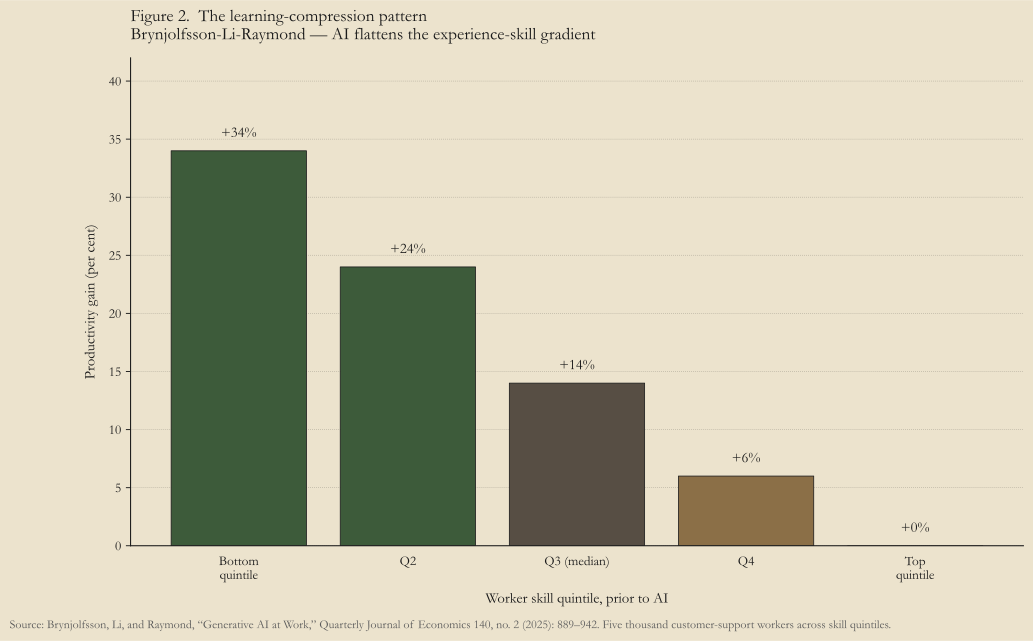
AI raised productivity for novice customer-support workers by 34 per cent and for top-quartile workers by approximately zero in the Brynjolfsson, Li, and Raymond field experiment.1 Learning compression. The on-ramp from novice to mid-tier — the part of a career the labour-economics literature spends most of its time on — is being flattened in months rather than crossed in years. Dell’Acqua, McFowland, and Mollick measured the jagged frontier on 758 BCG consultants: inside the boundary, AI was the productivity multiplier and time fell 25 per cent against the control while quality rose 40; outside the boundary, accuracy fell 19 percentage points because the model produced plausible-but-wrong outputs the consultant did not detect.2 Brynjolfsson, Chandar, and Chen documented a 13 per cent relative employment decline for workers aged 22 to 25 in AI-exposed occupations, with workers over 30 in the same occupations flat.3
Those three findings determine what an individual reader does. The first two are the texture of the labour market the reader enters; the third is what is happening at the bottom of it. The frameworks below are the discipline an honest analyst applies to advice when the constraints look like that. They are not prescriptions. They do not adjudicate values.
Start with the labour-market data. The Bureau of Labor Statistics 2024–2034 employment projections, published in August 2025, point to office-and-administrative-support employment declining in absolute terms — customer-service representatives at minus five per cent, medical transcriptionists at minus 4.7 per cent, claims adjusters at minus 5.1 per cent, all with explicit AI attribution in the BLS rationale.4 Healthcare-practitioner employment rises 7.2 per cent across the decade; healthcare support 12.4 per cent. Computer-and-mathematical occupations rise 10.1 per cent in aggregate but with sharp internal asymmetry — software developers up 15 per cent while computer programmers fall six.
The skilled trades stand out. Electricians at plus nine per cent, HVAC mechanics at plus eight, plumbers at plus four — all faster than the all-occupations average of three, all heavily physical, all hard for foreseeable robotics to substitute on the timescale of the Baumol window from chapter three.5
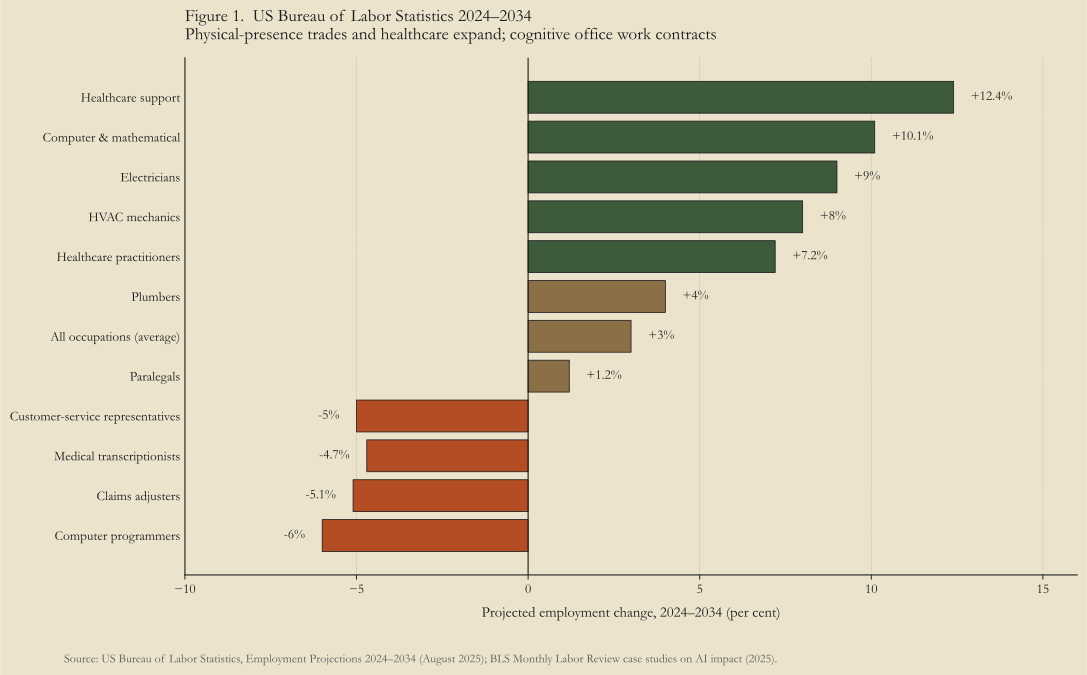
The aggregate picture is split. Cognitive office work that AI can substitute on a screen contracts; physical work that requires bodies in rooms expands. The middle of the cognitive distribution — paralegals, copywriters, customer-service representatives, translators — is the part the exposure indices agree on first. The career advice that follows is unsurprising in shape. Pick work AI cannot do alone, or pick work where AI is the leverage multiplier. The two ends of the fork are physical-presence trades and AI-complementary builder roles. The middle is the harder problem, because the middle is what the three empirical anchors are about.
The 22-to-25 cohort is the part of the labour market the Canaries paper is asking about, and the part the career-economics literature has most evidence on. Oreopoulos, von Wachter, and Heisz documented in 2012 that the first ten years of a career produce roughly seventy per cent of lifetime wage growth, mostly through firm-switching, and that recession-era entry produces persistent scarring — minus nine per cent in year one, minus four per cent in year five, minus two per cent in year nine.6 The Canaries finding raises the open question of whether AI is a cyclical shock that fades or a structural shock that does not.
The career-strategy implication is sharper than the portfolio implication. Learning compression is the load-bearing finding: AI is collapsing the on-ramp from novice to mid-level, which means the value of working in an institution that teaches a craft is also being compressed. The historical advice — get in at the bottom of a strong institution, take the first ten years seriously, accumulate craft and network — is therefore on weakened footing. The new advice runs to opposite poles. Either enter institutions whose accountability AI cannot substitute (medicine, law, finance with the regulatory load) or build directly with AI as the leverage multiplier. Maor Shlomo, the Israeli founder of Base44, built a vibe-coding platform on Claude alone, sold it to Wix for $80 million six months after launch with no employees at the date of acquisition.7 Anysphere’s Cursor reached $2 billion in annual recurring revenue thirteen months after $100 million.8 Both are the operationalised version of the second pole.
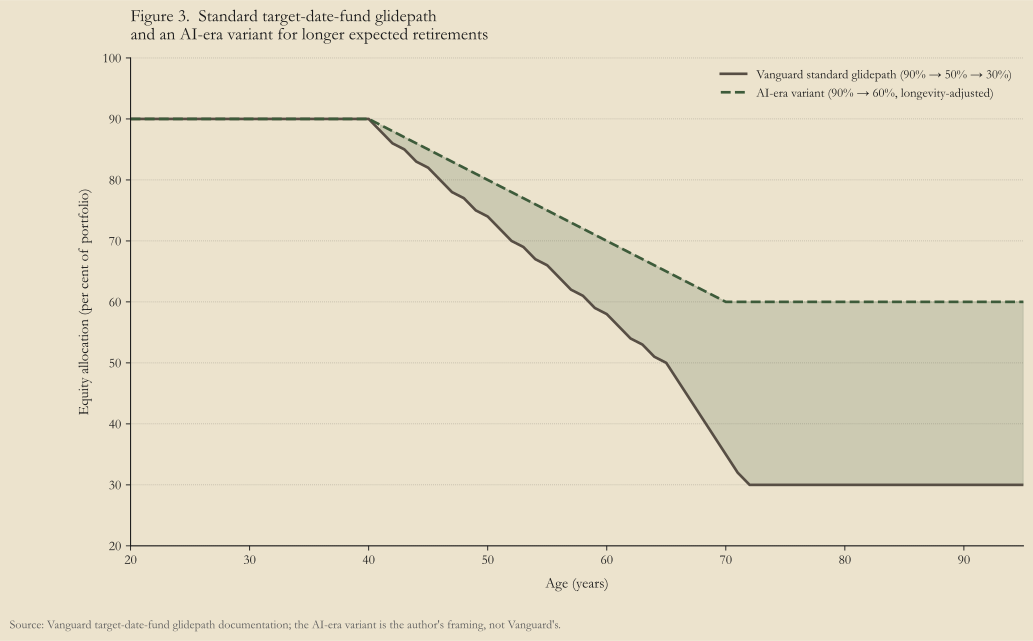
The risk-tolerance argument is classical. A 22-year-old’s wealth is almost entirely human capital. Financial capital, when it accumulates, should be skewed equity to diversify against the labour-income concentration — the textbook Bodie-Merton-Samuelson result. Vanguard’s standard target-date glidepath holds 90 per cent in equities at age 25.9
For the 30-to-45 cohort the optimisation problem reverses. Human capital is high but already specialised; financial capital is mid-build; family and mortgage constraints lower mobility. The OECD’s 2025 Employment Outlook finds that workers over forty-five make up roughly 44 per cent of long-term unemployment across surveyed OECD countries, and that on-the-job training — apprenticeships, rotation, role expansion — outperforms formal mid-career reskilling.10
The T-shaped professional framework is the conventional advice: deep domain expertise plus enough breadth to integrate AI tools without losing the depth that made the expertise valuable. Learning compression complicates it. If novices catch up to mid-tier workers in months rather than years, the depth that the T-shaped professional has accumulated is also somewhat commoditised. The defensible response is to lean harder into integration. The parts of an expert’s role that AI does not substitute are usually institutional, not technical. The senior radiologist’s value is less about reading the scan and more about being the named accountable party who signs the report. The senior lawyer’s, less about drafting the brief and more about the relationships and the judgement around it. The senior banker’s, the underwriting authority. The financial-portfolio argument in this band runs along the classical glidepath — 60 to 80 per cent equity, growing exposure to fixed income as the horizon shortens — with the qualification that the mortgage-as-leverage argument is exposed to the Baumol-window rent dynamic from chapter three. Housing in service-strained cities will likely outperform housing in over-built ones.
The over-fifties have the cleanest empirical position. The Canaries finding of no detectable AI displacement for workers 31-and-over holds. The Brynjolfsson-Li-Raymond skill compression is a force for the older cohort relative to younger replacements — the senior expert’s premium does not flatten, the novice’s gains do.
The optimisation problem in this cohort is therefore less about labour-market positioning and more about three other things: decumulation, longevity, and what to teach the next generation. The classical Vanguard glidepath drops equity from approximately 70 per cent at age fifty to 50 per cent at retirement and to 30 per cent seven years later.9 The ‘one hundred minus age’ rule is increasingly criticised as too conservative for thirty-year retirements; ‘110 minus age’ or ‘120 minus age’ are the current heuristics.11
The longevity component is real and growing. Insilico Medicine took an AI-designed drug from target discovery to first-in-human Phase 1 dosing in fourteen months in 2025; the GNoME materials work and the GraphCast / Aurora atmospheric models from chapter one are accelerating the upstream science.12 The actuarial tables current pension planning rests on do not yet price a meaningful AI-on-medicine acceleration. Plan for more years than the tables suggest.
The age framework is the first cut. The second cut is interest. Five reader-types absorb most of the rest of the chapter; read for the one closest to home.
The builder — engineer, scientist, founder — has the largest leverage multiplier in the history of the discipline. AI agents collapse the team size required to ship software, design a chip, or run a wet-lab experiment. The builder’s question is not whether to use AI but where in the stack to build — substrate (chip, energy, network), application layer (vertical product on top of a model), or the contested middle (frontier-lab competitor, requiring capital at the scale only a handful of firms have raised).
The specialist — physician, lawyer, accountant, civil engineer — has more reinstatement upside than the headline numbers suggest. The Dell’Acqua jagged frontier is the operating framework: inside the frontier, AI gives the specialist the productivity gain of a junior; outside the frontier, AI produces plausible-but-wrong outputs that the specialist’s training catches. The specialist’s job is to know which side of the frontier each task sits on.
The allocator — investor, asset manager, civil servant in finance, family-office principal — has the chapter VII argument as a day job. The substrate-versus-application-layer thesis, the rent-capture pattern, the sovereign-wealth-fund operationalisation all sit in the allocator’s brief.
The civic-minded — politician, civil servant, journalist, NGO professional — has the policy surface from chapter VII as work. The Danish institutional architecture either gets used or it does not. The chapter the reader has just read is the policy the civic-minded reader has to design.
The creative — writer, artist, designer, filmmaker — has the hardest framework to write. Generation eats the median; taste rises in value. The high-volume middle of the creative professions is being unbundled. The top and the genuinely distinctive are not.
What each archetype should actually read
The framework above is too schematic to operationalise without further reading. The builder gets the most from Mollick’s Co-Intelligence and from spending ten hours a week with the frontier models. The specialist gets the most from following the legal, medical, or professional-accountability developments in the specific domain and from being early to deploy AI tools internally rather than letting younger colleagues run ahead. The allocator gets the most from the BlackRock Investment Institute, the Norges Bank Investment Management quarterly letters, and the Anthropic Economic Index. The civic-minded gets the most from the OECD and IMF working-paper streams on AI and policy. The creative gets the most from the artists, writers, and designers thinking seriously about taste — and from the discipline of working in the medium that AI does worst.
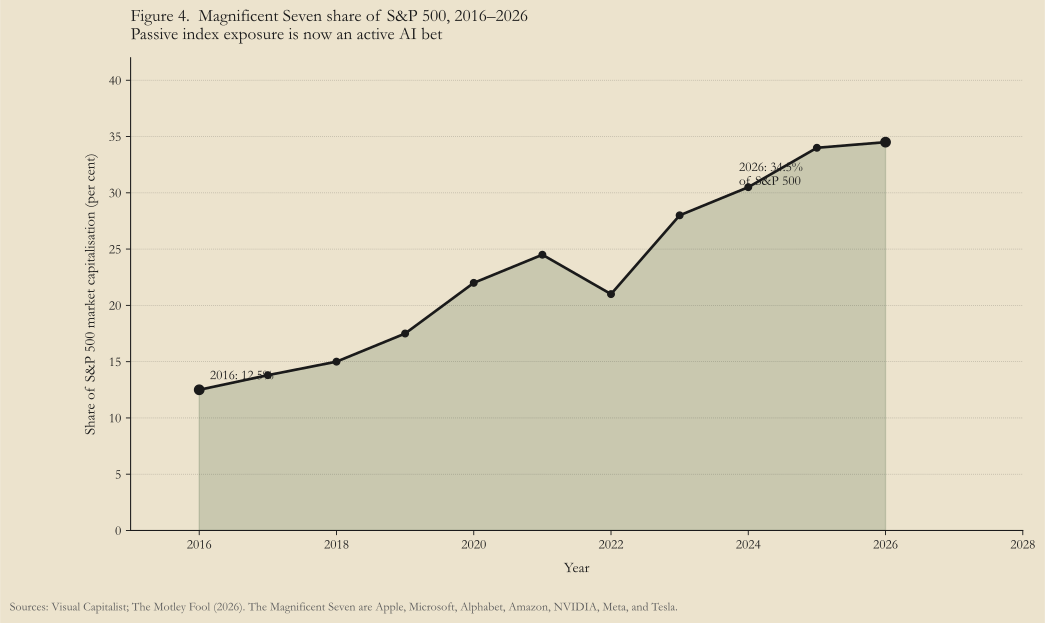
The portfolio framework follows three rules. First, passive index exposure is now an active AI bet. The Magnificent Seven make up roughly 34 per cent of the S&P 500.13 A 60/40 portfolio with sixty per cent in the index is therefore about 20 per cent in seven stocks. The equal-weight S&P (RSP) is the cleanest hedge against that concentration without leaving the index.
Second, the substrate-versus-application-layer thesis from chapter five points retail capital toward the substrate. Semiconductor ETFs (SMH, SOXX) and data-centre REITs are the available proxies; the frontier-lab equity layer is still private. International and small-cap exposure (VXUS, IWM) are diversifiers against US AI concentration; both outperformed US large-cap in 2025–2026.14
Third, the Baumol-window mechanism from chapter three has portfolio consequences. Housing in service-strained cities should outperform housing in over-built ones. Bonds, after the failure of 2022, are functioning as a hedge again — stock-bond correlation fell from 0.80 in mid-2024 to 0.16 by late 2025.15 Gold and Bitcoin are tail-risk hedges, not core positions; treat as one or two per cent insurance, not asset-allocation backbone.
The most common version of the AI-career question is asked by parents about teenagers. The advice converges across credible commentators. Patrick Collison has walked back his earlier “teens should move to San Francisco” line and now says successful examples of basically every strategy exist — though deep domain expertise remains valuable.16 Tyler Cowen’s Talent (2022) framework is that intelligence is overrated and personality is undervalued; his 2025 Marginal Revolution update is that the old good-grades playbook is obsolete.17 Ethan Mollick’s Co-Intelligence recommends ten hours a week of working with the frontier models, focusing on tasks rather than skills.18
The pattern in the labour-market data is more concrete than the advice columns. Skilled trades win durably. Healthcare practitioners and support roles win durably. STEM with AI literacy wins durably. Domain-specific work — medicine, law, engineering, accounting — combined with AI tools wins durably. The hollowed middle is the cognitive-office work the exposure indices agree on first.
The optimisation problem is real, age-stratified, interest-stratified, and not reducible to the policy question the next chapter takes apart. Both compound; neither absorbs the other. The reader who has the frameworks now has the time the Baumol window leaves before robotics closes it, and the time is shorter than the policy class has so far behaved as if it were.
Footnotes
-
Erik Brynjolfsson, Danielle Li, and Lindsey R. Raymond, “Generative AI at Work,” Quarterly Journal of Economics 140, no. 2 (2025): 889–942. Headline finding: +34 per cent productivity for the bottom quintile of customer-support agents, near-zero for the top quintile. ↩
-
Fabrizio Dell’Acqua, Edward McFowland III, Ethan Mollick, et al., Navigating the Jagged Technological Frontier: Field Experimental Evidence of the Effects of AI on Knowledge Worker Productivity and Quality, Harvard Business School Working Paper 24-013, 2023. ↩
-
Erik Brynjolfsson, Bharat Chandar, and Ruyu Chen, Canaries in the Coal Mine? Six Facts About the Recent Employment Effects of AI, Stanford Digital Economy Lab Working Paper, November 2025. ↩
-
US Bureau of Labor Statistics, Employment Projections 2024–2034, August 2025; case studies of AI impact: BLS Monthly Labor Review, “Incorporating AI Impacts in BLS Employment Projections,” 2025. ↩
-
US Bureau of Labor Statistics, Occupational Outlook Handbook: Electricians; HVAC; Plumbers. ↩
-
Philip Oreopoulos, Till von Wachter, and Andrew Heisz, “The Short- and Long-Term Career Effects of Graduating in a Recession,” American Economic Journal: Applied Economics 4, no. 1 (2012): 1–29. ↩
-
Maor Shlomo and Base44 sale to Wix, June 2025: TechCrunch; founder interview: Lenny’s Newsletter. ↩
-
Cursor / Anysphere annual recurring revenue trajectory: TechCrunch, June 2025; CNBC, November 2025. ↩
-
Vanguard target-date-fund glidepath documentation: Vanguard Workplace. Equity allocation falls from 90 per cent at age 25 to 50 per cent at age 65 and 30 per cent at age 72. ↩ ↩2
-
OECD, Employment Outlook 2025: Staying in the Game — Skills and Jobs of Older Workers in a Changing Labour Market, 2025. ↩
-
Modern critiques of the “100 minus age” heuristic: Kiplinger. Vanguard’s Total Return Income Glide-path documentation supports a higher equity share at retirement for thirty-year retirement horizons. ↩
-
Insilico Medicine’s INS018_055 from target discovery to first-in-human Phase 1 in roughly fourteen months: Insilico Medicine; coverage Longevity Technology. ↩
-
Magnificent Seven share of S&P 500 market capitalisation, 2025–2026: Visual Capitalist; Motley Fool. ↩
-
International and small-cap performance versus US large-cap, 2025–2026: VXUS trailing twelve-month +32 per cent vs VTI +22 per cent (24/7 Wall St.); Russell 2000 rotation Q1 2026 (Financial Content). ↩
-
Stock-bond correlation peaked at 0.80 in mid-2024 and fell to 0.16 by late 2025: Ainvest; CFA Institute. ↩
-
Patrick Collison, Dwarkesh Patel interview, 2025: Dwarkesh Podcast. ↩
-
Tyler Cowen and Daniel Gross, Talent: How to Identify Energizers, Creatives, and Winners Around the World (St. Martin’s Press, 2022); Cowen on AI and education, Marginal Revolution, February 2025: marginalrevolution.com. ↩
-
Ethan Mollick, Co-Intelligence: Living and Working with AI (Portfolio, 2024); CNBC commentary, October 2025: CNBC. ↩