The Economics of the AI Transition
II. The Coasean Singularity
Transaction costs approaching zero; why firms exist and what happens when they don't need to.
In February 2024 Klarna announced that an AI assistant built on OpenAI’s models had, in its first month of deployment, handled 2.3 million customer-service conversations — the work, the company said, of roughly seven hundred full-time agents. Resolution time fell from 11 minutes to 2. Customer-satisfaction scores held. Projected profit improvement was $40 million.1
By mid-2025 Klarna had partially walked it back, rehiring humans for complex cases and reframing the deployment as augmentation rather than replacement.2 The walkback is part of the data, not a contradiction of it. Something happened in 2024 that does not happen with the previous generation of customer-service software, and something else happened in 2025 that the headline numbers did not capture. The question this chapter answers is what.
Ronald Coase asked in 1937 why firms exist at all.3 If markets coordinate so well, why doesn’t all production happen through individual contracts between specialists? His answer founds modern industrial organisation: using the price mechanism is itself costly. Search costs, bargaining costs, drafting costs, monitoring costs, enforcement costs. The firm exists where it is cheaper to coordinate internally than to coordinate through the market. The firm’s boundary sits where the marginal cost of internalising a transaction equals the marginal cost of using the market.
The work that followed sharpened the answer. Williamson on asset specificity and opportunism (Nobel 2009); Grossman, Hart, and Moore on incomplete contracts and residual control rights (Hart and Holmström, Nobel 2016).4 The framework has been stable for nearly ninety years. It implies a precise prediction: when transaction costs fall, the firm boundary moves outward. What used to require internal coordination can now be procured through the market instead.
Shahidi, Rusak, Manning, Fradkin, and Horton, in the 2025 NBER volume The Economics of Transformative AI, give the AI version of this argument a name: the Coasean singularity.5 Tyler Cowen amplified it on Marginal Revolution that October.6 The phrase is new; the underlying mechanics are not.
The substrate of the Coasean singularity is the collapsing cost of cognition. According to Epoch AI, the median price for fixed AI capability falls roughly fifty-fold per year; for some milestones the rate is two hundred-fold per year.7 Anthropic’s own pricing curve shows the shape: Opus 4.1 was priced at $15 per million input tokens and $75 per million output; Opus 4.7 is $5 and $25. Sonnet held at $3 and $15 across major version changes. Inference prices are falling faster than chip prices ever did.
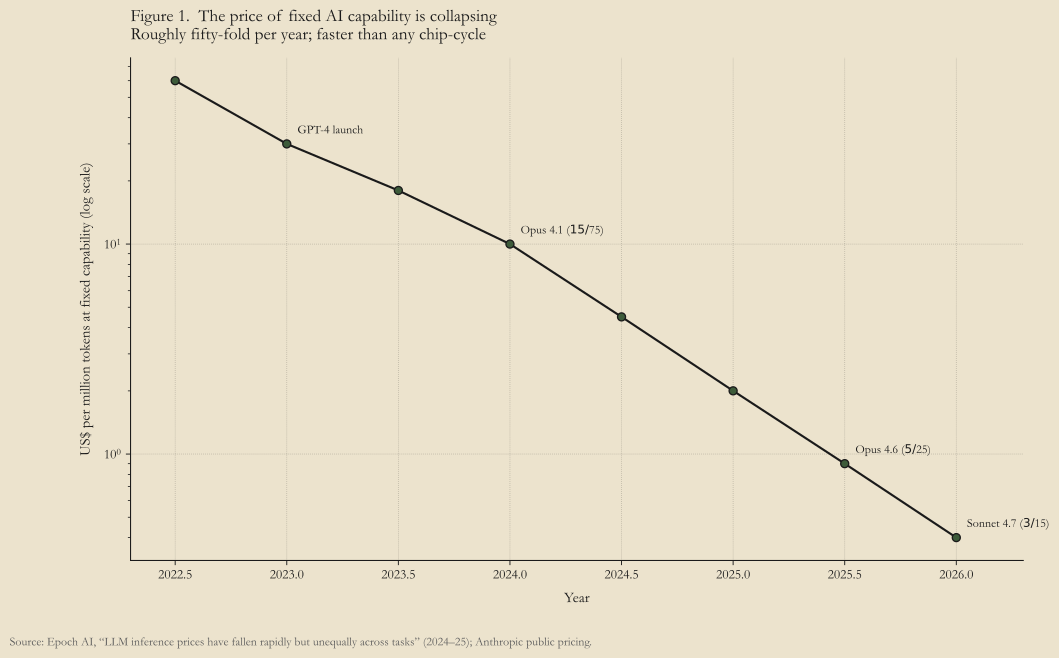
A contract negotiation, a procurement review, a legal markup, a routine accounts-payable matching — each has a cognitive cost that used to be paid in human attention at, call it, $200 an hour. Done by a language model inside a tool-use loop, the cognitive cost is closer to two cents. The Coasean prediction does not need a leap of imagination. It needs only the inference-cost curve to continue.
The Coasean shock has empirical precedent. Brynjolfsson, Malone, Gurbaxani, and Kambil documented in 1994 that IT investment was associated with subsequent decreases in average firm size, with a two- to three-year lag.8 Hitt confirmed in 1999, on a panel of 549 large US firms over eight years, that greater IT use was associated with significant decreases in vertical integration.9 Bernhofen, El-Sahli, and Kneller estimate that without the shipping container — the canonical pre-digital transaction-cost shock — US maritime exports would have been 14 to 21 per cent lower in the late twentieth century.10
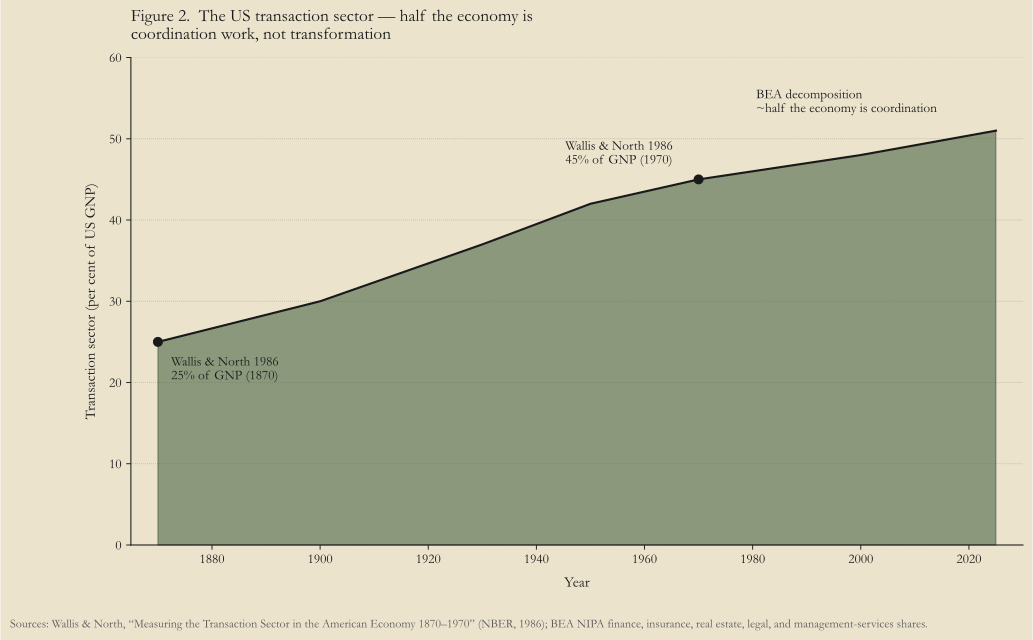
The aggregate macro story is older still. Wallis and North estimated in 1986 that the transaction sector of the US economy — the part of GNP devoted to coordination rather than transformation — grew from roughly 25 per cent in 1870 to 45 per cent in 1970.11 Half the modern American economy is coordination work, not making things. That share is the relevant denominator for what is being unbundled.
The honest reading of the IT episode is that effects are real, moderate, and lagged. Firms got smaller in average headcount. Vertical integration loosened. But firms did not dissolve into atomistic markets, and the chapters that follow turn on which features of the firm are doing the persisting.
What we already know from controlled experiments on current AI systems is that the productivity effects are large where the task fits the model and zero or negative where it does not.
In a five-thousand-agent customer-support study, Brynjolfsson, Li, and Raymond measured a 14 per cent increase in issues resolved per hour across all workers, a 34 per cent increase for novices, and approximately zero gain for top-quartile experts.12 Peng et al., in a GitHub randomised trial, found that engineers given Copilot completed an HTTP-server task 55.8 per cent faster than the control group.13 Cui and co-authors, in three RCTs of nearly five thousand developers across Microsoft, MIT, Princeton, and Wharton, measured a 26 per cent increase in completed pull requests.14 In Dell’Acqua, McFowland, Mollick, and the BCG Henderson Institute’s study of 758 consultants, time on inside-the-frontier tasks fell 25 per cent and quality rose 40 per cent — and accuracy on outside-the-frontier tasks fell 19 percentage points.15 Goldman Sachs projects 7 per cent additional global GDP growth (roughly $7 trillion) and 1.5 percentage points of added productivity growth over a decade.16
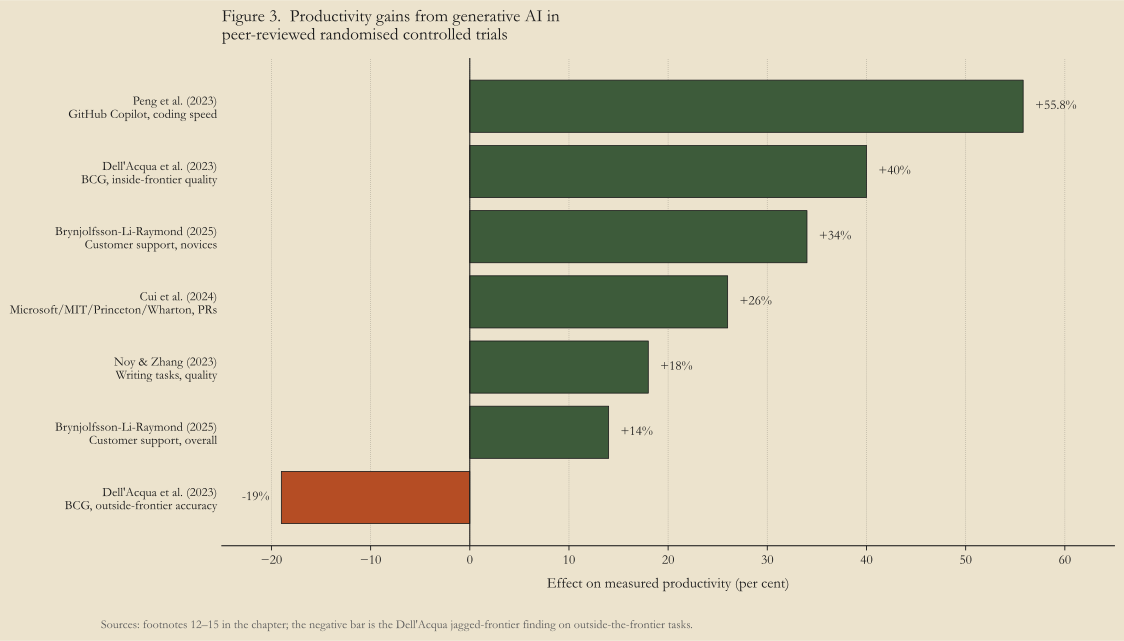
The Dell’Acqua finding matters most. The jagged frontier — the boundary between tasks AI can do well and tasks it does badly — is irregular and not always visible to the operator. The firm that captures the gain is the firm that learns where the boundary sits.
The jagged frontier, in one paragraph
Dell’Acqua and co-authors gave 758 BCG consultants a battery of analytical and writing tasks. Some sat clearly inside the frontier of GPT-4’s capabilities — competitive analysis, summarising research, drafting marketing copy. Some sat clearly outside it — quantitative tasks requiring access to specific BCG data the model could not have seen. Consultants with the model outperformed the control on inside-the-frontier tasks by every measure; on outside-the-frontier tasks the model-using group was significantly worse, because the model produced plausible answers that were wrong and the consultants did not detect the difference. The boundary between in and out was not a clean line. A firm that deploys the technology without internal taste for that boundary captures the average of the two effects, which is much less than the inside-the-frontier gain.
The strongest case against the Coasean singularity argues that the metaphor does too much work.
Friedrich Hayek’s 1945 paper frames coordination as a knowledge problem, not a transaction-cost problem — much of what an experienced employee knows is tacit, local, and resistant to codification.17 AI agents trained on text are weakest where Polanyi’s paradox is strongest. Cheap negotiation does not help with knowledge that cannot be written down.
Daron Acemoglu’s 2024 Simple Macroeconomics of AI puts an upper bound on AI’s near-term productivity contribution at 0.66 per cent of total factor productivity over ten years, from a bottom-up Hulten accounting.18 MIT’s Project NANDA reported in August 2025 that 95 per cent of enterprise AI pilots showed no measurable profit-and-loss impact, despite $30–40 billion of corporate spend.19 METR’s 2025 measurement of AI time-horizon capability finds that frontier models reliably complete tasks of a few minutes’ duration; the 50-per-cent-success time horizon doubles every roughly seven months.20 Multi-hour autonomous agency, the kind a literal Coasean-singularity argument requires, is on the trend curve, not the deployment one.
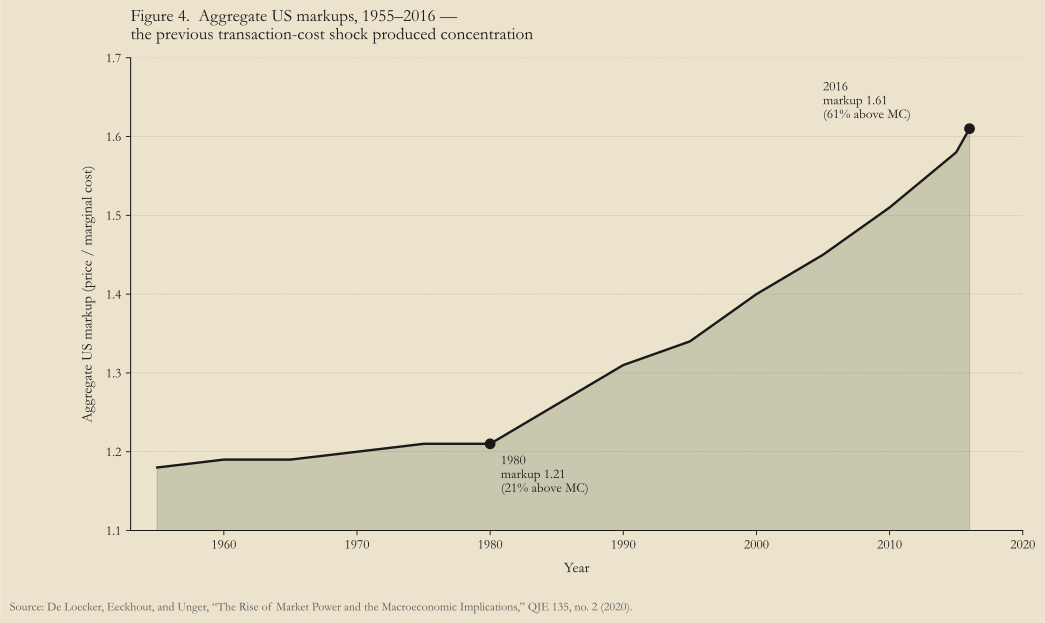
The harder objection is historical. The last great transaction-cost shock — the internet — increased industry concentration rather than dissolving it. Autor, Dorn, Katz, Patterson, and Van Reenen show that the share of value captured by superstar firms rose sharply after 1982.21 De Loecker, Eeckhout, and Unger estimate that aggregate US markups rose from 21 per cent above marginal cost in 1980 to 61 per cent in 2016.22 The previous Coasean shock did not produce atomistic markets. It produced larger winners.
There is one more friction, and it sits in the courts. In Moffatt v. Air Canada (2024), a Canadian tribunal held the airline liable after its chatbot invented a bereavement-fare policy.23 The EU AI Act, finalised the same year, explicitly rejected the concept of electronic personhood: AI agents bind principals through classical agency law, and the principal is the firm.24 The agent is still the firm’s speech, in law and in commercial practice. Whatever the Coasean singularity unbundles, it does not unbundle liability.
What the evidence supports is more interesting than the headline. Transaction costs are falling fast, but firms are not dissolving. What dissolves is the inside of the firm — the coordination layers, the middle administration, the contracting friction, the document review, the customer-service triage. What persists is the outer membrane — trust, accountability, reputation, capital allocation, direction-setting, liability. Firms become hollower, smaller in headcount, more concentrated at the top. They do not vanish into markets. The Klarna walkback is what that re-equilibration looks like in real time.
That is the substrate condition the rest of this essay runs against. The cognitive layer of every service sector is being unbundled fast. The physical layer is not. The welfare state runs on the physical layer, and the wage curve runs through both on the same clock. The Coasean unbundling has met its hard limit, and the limit is Baumol.
Footnotes
-
Klarna, “Klarna AI assistant handles two-thirds of customer service chats in its first month,” February 2024; OpenAI, “Klarna,” customer story, 2024. ↩
-
Gergely Orosz, “The Pulse: Klarna’s AI chatbot was a customer service disaster,” The Pragmatic Engineer, 2025. Klarna reframed the deployment as customer-service augmentation and rehired human agents for complex tickets. ↩
-
Ronald H. Coase, “The Nature of the Firm,” Economica 4, no. 16 (1937): 386–405. Coase received the Nobel Memorial Prize in Economic Sciences in 1991. ↩
-
Oliver E. Williamson, Markets and Hierarchies (Free Press, 1975); The Economic Institutions of Capitalism (Free Press, 1985); Nobel 2009. Sanford J. Grossman and Oliver D. Hart, “The Costs and Benefits of Ownership,” Journal of Political Economy 94, no. 4 (1986): 691–719. Oliver Hart and John Moore, “Property Rights and the Nature of the Firm,” Journal of Political Economy 98, no. 6 (1990): 1119–1158. Hart and Bengt Holmström shared the Nobel in 2016. ↩
-
Paymon Shahidi, Gergely Rusak, Benjamin S. Manning, Andrey Fradkin, and John J. Horton, “The Coasean Singularity? Demand, Supply, and Market Design with AI Agents,” Chapter 6 in Ajay Agrawal, Erik Brynjolfsson, and Anton Korinek (eds.), The Economics of Transformative AI (University of Chicago Press / NBER, 2025). ↩
-
Tyler Cowen, “Will there be a Coasean singularity?,” Marginal Revolution, 22 October 2025. ↩
-
Epoch AI, “LLM inference prices have fallen rapidly but unequally across tasks,” 2024–2025. Anthropic pricing from platform.claude.com/docs/en/about-claude/pricing. ↩
-
Erik Brynjolfsson, Thomas Malone, Vijay Gurbaxani, and Ajit Kambil, “Does Information Technology Lead to Smaller Firms?,” Management Science 40, no. 12 (1994): 1628–1644. ↩
-
Lorin M. Hitt, “Information Technology and Firm Boundaries: Evidence from Panel Data,” Information Systems Research 10, no. 2 (1999): 134–149. ↩
-
Daniel M. Bernhofen, Zouheir El-Sahli, and Richard Kneller, “Estimating the effects of the container revolution on world trade,” Journal of International Economics 98 (2016): 36–50. ↩
-
John J. Wallis and Douglass C. North, “Measuring the Transaction Sector in the American Economy, 1870–1970,” in Long-Term Factors in American Economic Growth (NBER, University of Chicago Press, 1986), 95–162. ↩
-
Erik Brynjolfsson, Danielle Li, and Lindsey R. Raymond, “Generative AI at Work,” NBER Working Paper 31161, 2023 (updated 2025). ↩
-
Sida Peng et al., “The Impact of AI on Developer Productivity: Evidence from GitHub Copilot,” arXiv:2302.06590, 2023. ↩
-
Zheyuan (Kevin) Cui et al., “The Effects of Generative AI on High-Skilled Work: Evidence from Three Field Experiments with Software Developers,” Microsoft Research / MIT / Princeton / Wharton, 2024. ↩
-
Fabrizio Dell’Acqua, Edward McFowland III, Ethan Mollick, et al., “Navigating the Jagged Technological Frontier: Field Experimental Evidence of the Effects of AI on Knowledge Worker Productivity and Quality,” Harvard Business School Working Paper 24-013, 2023. ↩
-
Joseph Briggs and Devesh Kodnani, “The Potentially Large Effects of Artificial Intelligence on Economic Growth,” Goldman Sachs Economics Research, March 2023. ↩
-
Friedrich A. Hayek, “The Use of Knowledge in Society,” American Economic Review 35, no. 4 (1945): 519–530. The connection to AI runs through Polanyi’s paradox: see David H. Autor, “Polanyi’s Paradox and the Shape of Employment Growth,” NBER Working Paper 20485, 2014. ↩
-
Daron Acemoglu, “The Simple Macroeconomics of AI,” NBER Working Paper 32487, 2024. ↩
-
MIT Project NANDA, “The GenAI Divide: State of AI in Business 2025,” August 2025. The 95-per-cent figure refers to enterprise pilots without measurable P&L impact; the underlying sample is 153 surveys and 52 interviews, so treat as a snapshot of pilots, not a steady-state estimate. ↩
-
Model Evaluation and Threat Research (METR), “Measuring AI Ability to Complete Long Tasks,” March 2025. The 50-per-cent-success time horizon doubles every approximately seven months across the frontier-model series. ↩
-
David Autor, David Dorn, Lawrence F. Katz, Christina Patterson, and John Van Reenen, “The Fall of the Labor Share and the Rise of Superstar Firms,” Quarterly Journal of Economics 135, no. 2 (2020): 645–709. ↩
-
Jan De Loecker, Jan Eeckhout, and Gabriel Unger, “The Rise of Market Power and the Macroeconomic Implications,” Quarterly Journal of Economics 135, no. 2 (2020): 561–644. ↩
-
Moffatt v. Air Canada, 2024 BCCRT 149. Tribunal coverage: CBC News. Legal analysis: McCarthy Tétrault, “Moffatt v. Air Canada: Misrepresentation by AI Chatbot.” ↩
-
European Parliament, “EU AI Act: First regulation on artificial intelligence,” 2024. On agency-law application: Proskauer Rose, “Contract Law in the Age of Agentic AI.” ↩