The Economics of the AI Transition
I. Energy and Climate
The climate worry about AI energy demand, taken seriously and then in context.
The most common objection to the AI buildout is climate. It is a serious objection, and the numbers behind it are real.
The International Energy Agency projects global data-centre electricity rising from roughly 415 TWh in 2024 to 945 TWh by 2030 — about three per cent of global power.1 Indirect emissions from data centres reach roughly 1.4 per cent of global combustion CO₂ on the same trajectory, or about 1.7 gigatonnes.2 Microsoft’s reported emissions are 23 per cent higher than its 2020 baseline despite a 34 GW portfolio of contracted carbon-free electricity.3 Google’s are up 48 per cent over a comparable window.4 The objection is not that the demand is imagined.
What 1.4 per cent buys you, against what it costs, is the question. Aviation is roughly 2.5 per cent of global emissions, cement 7, road transport 15, agriculture and land use 18.5 No published 1.5°C or 2°C pathway in the IPCC’s AR6 carves out AI as its own scenario, because the share at the headline level is too small to model independently. The absence is data: nobody whose job is to model climate trajectories thinks AI is a phase change on the input side.
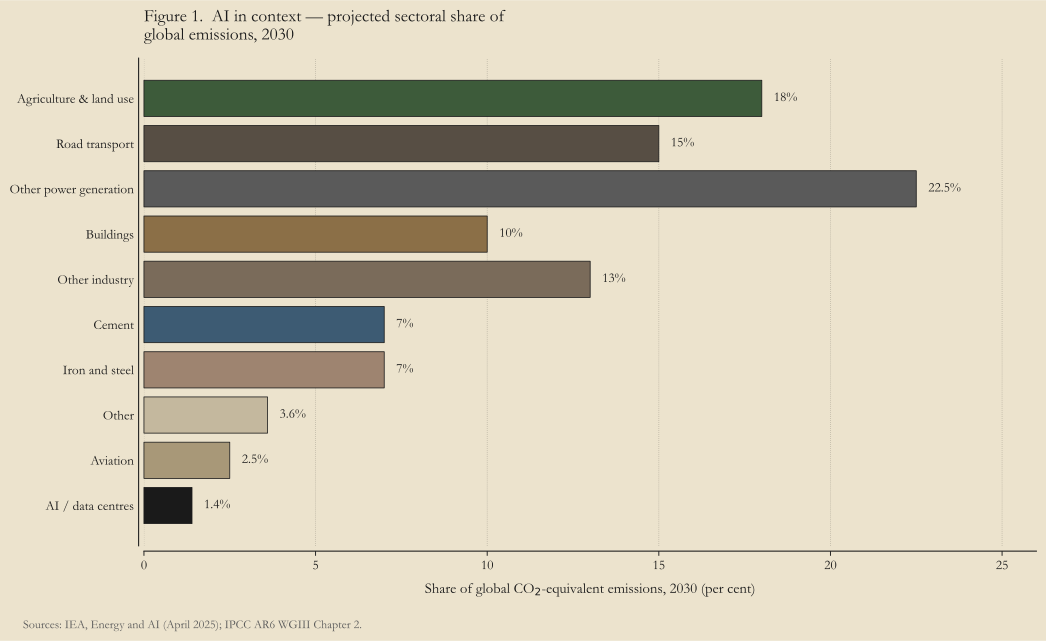
This is not the same as saying the marginal cost is zero. The cumulative emissions are real and rising. But they are an addition to a problem already sized by other sectors, not a transformation of its scale. The question is whether the addition is worth what it buys.
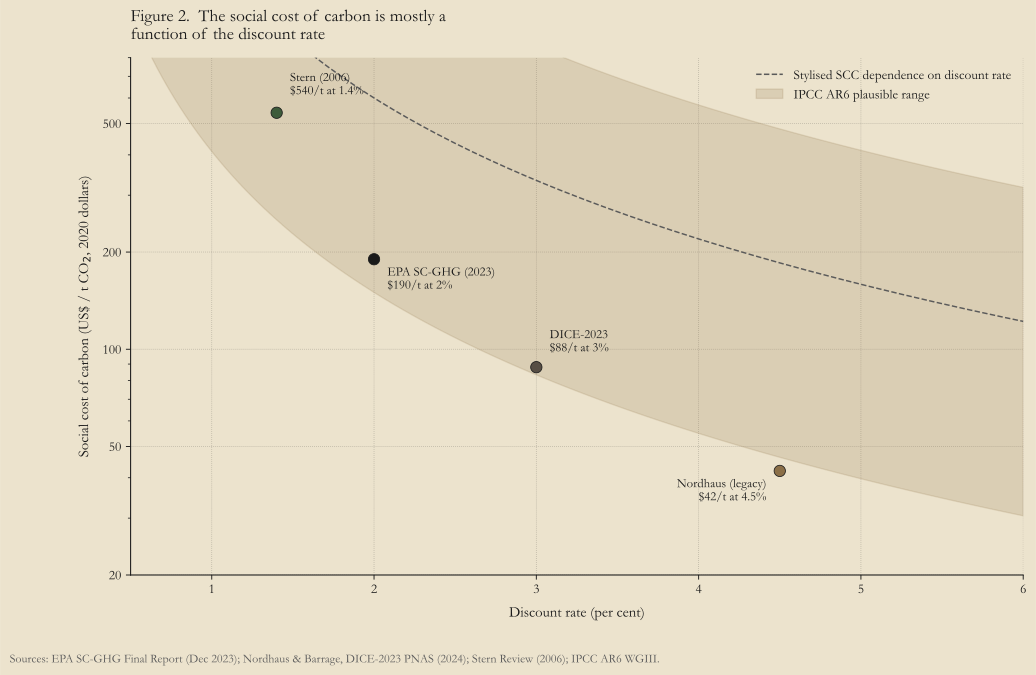
What does a ton cost? The US Environmental Protection Agency’s 2023 social-cost-of-carbon assessment puts the central estimate at $190 per ton of CO₂ in 2020 dollars at a 2 per cent discount rate, with a range of $120–$340.6 Nordhaus and Barrage’s DICE-2023 model produces a similar order of magnitude.7 At the other end, Stern’s 0.1 per cent pure-time-preference assumption produces numbers an order of magnitude higher again.8 The answer to “how bad is a ton” depends almost entirely on the discount rate, and the discount rate is a values choice — how heavily we weight a future person against a present one.
Why the discount rate carries the argument
The social cost of carbon is the present-value of damages from emitting one additional ton of CO₂. Calculating it requires choosing a rate at which to discount future damages back to today. A higher rate makes a damage that arrives in 2100 less consequential to a 2025 decision. The Ramsey formula decomposes the rate into a pure-time-preference term (how much a planner intrinsically prefers present over future welfare) and a growth-related term. Nordhaus and the EPA work with rates calibrated to observed market behaviour. Stern argues pure time preference between generations is ethically near-zero. Weitzman’s fat-tails work shows that under sufficient damage-distribution uncertainty, the integral diverges and the calculation breaks down entirely. None of this is settled, and the unsettled-ness is the point: the SCC literature does not produce a number, it produces a sensitivity table.
Set the SCC question aside for a moment. The deeper economic point is that pricing tons is the static framing. The dynamic framing is Acemoglu, Aghion, Bursztyn, and Hémous: “The Environment and Directed Technical Change” (American Economic Review, 2012).10 Their result is that when clean and dirty inputs are sufficiently substitutable in the production function, temporary clean-tech subsidies and research support permanently redirect innovation away from the dirty corner. The economy switches tracks; restriction is unnecessary. In their model the substitution required a policy decision.
The hyperscaler bid for clean firm power is that policy decision, made privately, at scale, by the largest-balance-sheet companies in the world. Subsidy by procurement. The question Acemoglu posed in 2012 has been answered by Big Tech in 2024–26 — answered as “yes, with private money, for our own reasons.” That changes the climate-economics problem before the climate-economics literature has finished updating its models.
The climate movement spent twenty years trying to manufacture demand for clean firm power against a public that wanted cheap fossil power. It now has the demand — large, urgent, capitalised, willing to pay above-fossil margins for clean capacity that cannot be intermittent. The bid for new nuclear, new geothermal, long-duration storage, and gas with carbon capture as a bridge is coming from the hyperscalers, because their inference loops cannot be intermittently powered and their stakeholders cannot wear the carbon.
Microsoft restarted Three Mile Island Unit 1 under a twenty-year offtake at 835 MW.11 Amazon contracted up to 1.92 GW of Susquehanna nuclear from Talen Energy through 2042.12 Google committed to 500 MW of Kairos small modular reactors with first delivery in 2030.13 Meta announced up to 6.6 GW of nuclear capacity across Vistra, Oklo, and TerraPower in January 2026.14 Google is also taking 115 MW of operational geothermal from Fervo today, scaling toward 500 MW by 2028.15 Corporate clean-power PPAs hit a record 62 GW globally in 2024, with Big Tech accounting for 84 per cent of deals.16
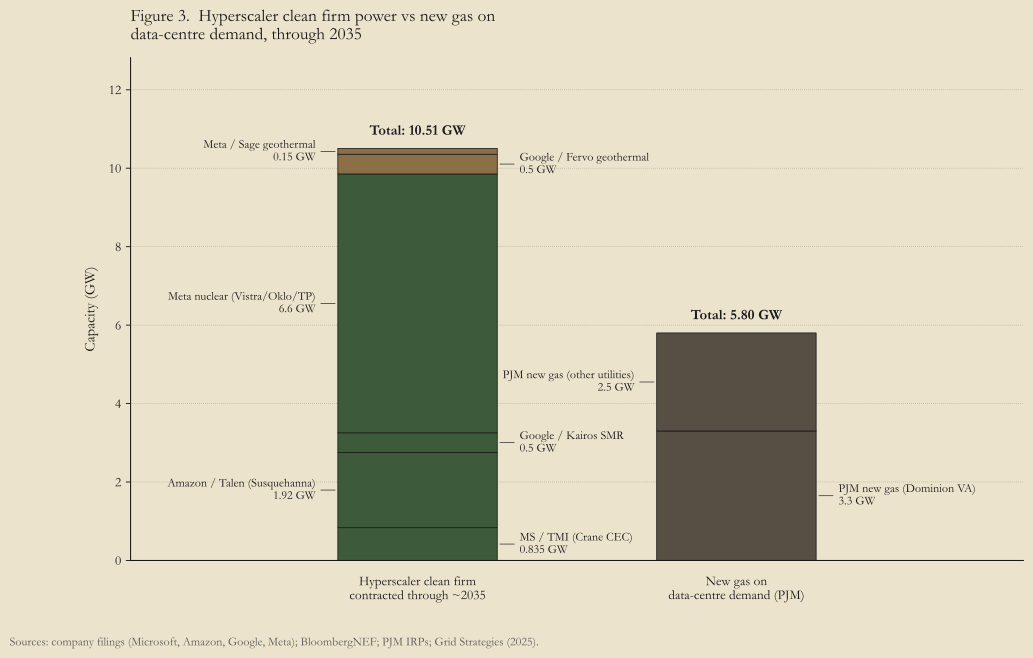
This is the largest private nuclear procurement in the history of the United States. The honest qualifier is that gas plants are being built on the same demand signal. PJM’s capacity-auction clearing price rose roughly elevenfold between 2024 and 2025, driven largely by data-centre load, and Dominion’s Virginia resource plan adds five-plus new gas plants.17 The substrate buildout is clean over time and gas in the meantime. The meantime matters.
The strongest objection to the structural-buyer reframe is the rebound. Luccioni and co-authors, in a FAccT 2025 paper, document that per-query AI inference carbon has fallen on every major model since 2021 — and that absolute reported emissions at Google are nonetheless 48 per cent higher than the 2019 baseline.4 Per-token cost falls; total tokens rise faster. The efficiency gains do not save us automatically. Jevons applies.
This is real. It does not change the marginal-cost framing. The question is still whether the marginal value of the next token — productivity, science, decarbonisation tools — exceeds the marginal cost of the energy and emissions that produce it. The rebound argues for honest carbon pricing inside the buildout, not against the buildout. A high-cost world where AI inference is correctly priced is still a world that builds AI.
The harder claim, and the one I am least sure of, is that AI itself accelerates the climate solution. The verified upstream evidence is genuine. DeepMind’s GNoME predicted 2.2 million new stable crystals, of which 736 were independently synthesised at the time of publication — an order-of-magnitude expansion of the materials known to be experimentally feasible.18 GraphCast and Microsoft’s Aurora cut 10-day weather forecasts from supercomputer-hours to single-TPU minutes while outperforming the European Centre’s deterministic model on most targets.19 DeepMind’s reinforcement-learning controller successfully ran live on the EPFL Swiss Plasma Center’s TCV tokamak — the first RL plasma control achieved in hardware.20 DeepMind’s data-centre cooling agent cut Google’s cooling energy by 40 per cent in production.21
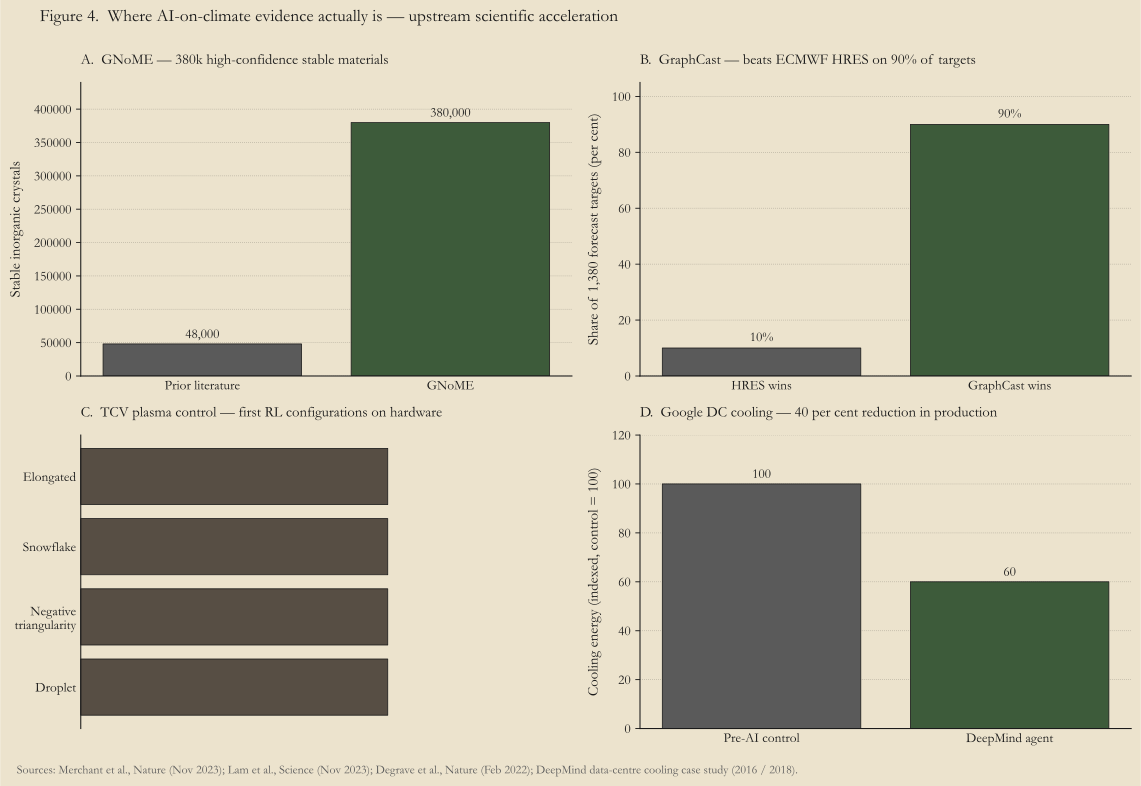
What this is: upstream scientific acceleration in forecasting, materials screening, and plasma control. What this is not: deployed commercial decarbonisation. The pipeline from an in-silico stable crystal to a commercial battery cell is still long. Treat AI-on-climate as a tailwind on the central argument, not the argument. Overclaiming the tailwind is the fastest way to lose credibility on a thesis that does not need it.
Energy and GDP have always moved together
The relationship between energy consumption and economic output is one of the most stable in macroeconomics. Through the long twentieth century, energy use and GDP rose roughly in lockstep, the elasticity close to one. The apparent decoupling of OECD economies since 1980 — output rising faster than energy use — is partly real efficiency gain and partly artefact: energy-intensive production was offshored to non-OECD economies, which then exported the goods back. On the global ledger, the coupling is far tighter than the headline figures suggest. AI does not break the relationship. It returns it to baseline. The economy becomes more productive per kilowatt and simultaneously produces more kilowatts of growth.
The central question of this chapter is not whether AI is worth its climate cost in isolation. That is the wrong frame. AI is happening because of productivity, science, and civilisational stakes — the rest of this essay takes those apart. Climate is one criterion among several, and on the climate criterion alone the calculation does not argue against. As well, it plausibly accelerates the solution side.
The short-term marginal-temperature worry is being traded for two things at once. The first is a technology that, even if its climate-solution contribution turns out to be zero, is the only structural private buyer of clean firm power in the energy transition’s twenty-year history. The second is the option on a technology that solves a far larger problem set, climate included. The cost is a fraction of one per cent of the global emissions trajectory. The trade is good even on a strict climate calculus.
Refusing to build is not a climate strategy. It is a strategy of being downstream of someone else’s build, in a world where someone else’s build still happens — and where the only counterfactual is who is doing the buying.The climate question for AI is not whether the demand happens but how it is powered. That is a question with real answers — nuclear restart, geothermal, transmission build-out, long-duration storage, gas with carbon capture as a bridge — and a question on which the AI buildout aligns the political coalition rather than splitting it. The chapters that follow leave climate behind. What remains is the economics of what the demand produces, and who captures it.
Footnotes
-
International Energy Agency, Energy and AI, April 2025. Base-case trajectory; the report’s “Lift-Off” case is higher. ↩
-
International Energy Agency, Energy and AI — AI and Climate Change, April 2025. Currently around 0.5 per cent of global combustion CO₂; reaches 1.0 per cent in the base case and 1.4 per cent in the “Lift-Off” case by 2030 (≈1.7 Gt). ↩
-
Microsoft, 2025 Environmental Sustainability Report, 2025: 34 GW of carbon-free electricity under contract, 19 GW signed in 2024, Scope 1+2+3 emissions 23.4 per cent above 2020 baseline. ↩
-
Sasha Luccioni et al., “From Efficiency Gains to Rebound Effects: The Problem of Jevons’ Paradox in AI’s Polarized Environmental Debate,” FAccT 2025 / arXiv:2501.16548. Documents per-query intensity gains alongside absolute-emissions growth at Google (+48 per cent vs 2019 baseline). ↩ ↩2
-
IPCC, Sixth Assessment Report — Working Group III, Chapter 2, 2022, sectoral emissions decomposition. ↩
-
US Environmental Protection Agency, Report on the Social Cost of Greenhouse Gases, December 2023. Central SC-CO₂ estimate of $190 per ton in 2020 dollars at a 2 per cent near-term Ramsey discount rate; the underlying range is $120–$340 across discount-rate cases. ↩
-
William Nordhaus and Lint Barrage, “Policies, Projections, and the Social Cost of Carbon: Results from the DICE-2023 Model,” Proceedings of the National Academy of Sciences, March 2024. The 2023 calibration raises the SCC materially relative to DICE-2016 and lowers the modelled optimal temperature target. ↩
-
Nicholas Stern, The Economics of Climate Change: The Stern Review, HM Treasury, 2006. Pure-time-preference rate set at 0.1 per cent on ethical grounds; criticised by Nordhaus, Weitzman, and Dasgupta as values-driven rather than empirically anchored. ↩
-
Kirsten Halsnæs, professor of climate economics at DTU Management; presentation at CEPOS Akademi on the climate economics of AI. Attribution and exact date pending confirmation — contact CEPOS Akademi. ↩
-
Daron Acemoglu, Philippe Aghion, Leonardo Bursztyn, and David Hémous, “The Environment and Directed Technical Change,” American Economic Review 102, no. 1 (2012): 131–166. The canonical formal model of clean-tech-versus-dirty-tech innovation under directed-policy support; the result that temporary subsidies suffice to switch tracks turns on sufficient input substitutability. ↩
-
Constellation Energy, “Constellation to Launch Crane Clean Energy Center, Restoring Jobs and Carbon-Free Power to The Grid,” September 2024. Twenty-year offtake of 835 MW from the restarted Three Mile Island Unit 1 (rebranded Crane Clean Energy Center) to Microsoft, targeted online 2027–28. ↩
-
Amazon Web Services, “AWS to invest $650 million in Talen Energy’s Pennsylvania nuclear data campus,” March 2024; subsequent ISA filings extend the contracted draw at Susquehanna Steam Electric Station to up to 1,920 MW through 2042. ↩
-
Google and Kairos Power, “Google and Kairos Power partner to deploy 500 MW of clean electricity generation,” October 2024. First small-modular reactor target online 2030; full 500 MW fleet through 2035. ↩
-
Meta, “Bringing Nuclear Energy Online to Power American AI Leadership,” January 2026. Up to 6.6 GW across offtakes from existing Vistra plants and contracted SMR capacity from Oklo and TerraPower; figures are headroom, not financed capacity. ↩
-
Google, “A first-of-its-kind geothermal project is now operational,” Sustainability blog, November 2023; Fervo Energy, “Fervo Energy Raises $462 Million Series E,” 2024. 115 MW operational at Cape Station; second phase targets 500 MW by 2028. ↩
-
BloombergNEF, Corporate Energy Market Outlook 2025 (cited via Utility Dive). Record 62 GW of corporate PPAs globally in 2024; Big Tech 84 per cent of deals and roughly half of global volume. ↩
-
Institute for Energy Economics and Financial Analysis, “Projected data center growth spurs PJM capacity prices to factor of 10 increase,” 2025; Grid Strategies, National Load Growth Report 2025. PJM clearing prices rose from $28.92 to $329.17 per MW-day; Dominion’s Virginia integrated resource plan adds five-plus new gas plants under the data-centre load forecast. ↩
-
Amil Merchant et al., “Scaling deep learning for materials discovery,” Nature 624 (November 2023): 80–85. GNoME identified 2.2 million predicted stable crystalline materials; 380,000 with high confidence; 736 had been independently experimentally synthesised at time of publication. ↩
-
Remi Lam et al., “Learning skillful medium-range global weather forecasting,” Science 382 (November 2023): 1416–1421; Cristian Bodnar et al., “A foundation model for the Earth system,” Nature (May 2025). GraphCast beats the ECMWF HRES deterministic model on 90 per cent of 1,380 targets at 0.25° resolution; Aurora beats GraphCast on 94 per cent of targets and is roughly five thousand times faster than the IFS. ↩
-
Jonas Degrave et al., “Magnetic control of tokamak plasmas through deep reinforcement learning,” Nature 602 (February 2022): 414–419. Deep-RL controller deployed live on the EPFL Swiss Plasma Center’s TCV tokamak; produced elongated, negative-triangularity, snowflake, and droplet plasma configurations. ↩
-
DeepMind, “DeepMind AI Reduces Google Data Centre Cooling Bill by 40%,” 2016; autonomous-control follow-up 2018. Forty per cent reduction in cooling energy and a roughly 15 per cent improvement in total power-usage effectiveness, in production. ↩