No Winning Strategy
Why catch-up is no longer possible for countries outside the AI production chain
What should countries which are not currently in the AI production chain (semis, energy, frontier models, robotics) do in order to not get totally sidestepped by transformative AI?
— Dwarkesh Patel
The premise of the question is that there is a winning strategy. I do not think there is. Not for Denmark, and not for anyone else outside the frontier. The risk is not poverty; we’ll be richer in absolute terms than almost anyone alive today. The risk is being downstream of an intelligence one doesn’t shape, and the gap between owner and user widening as the system grows.
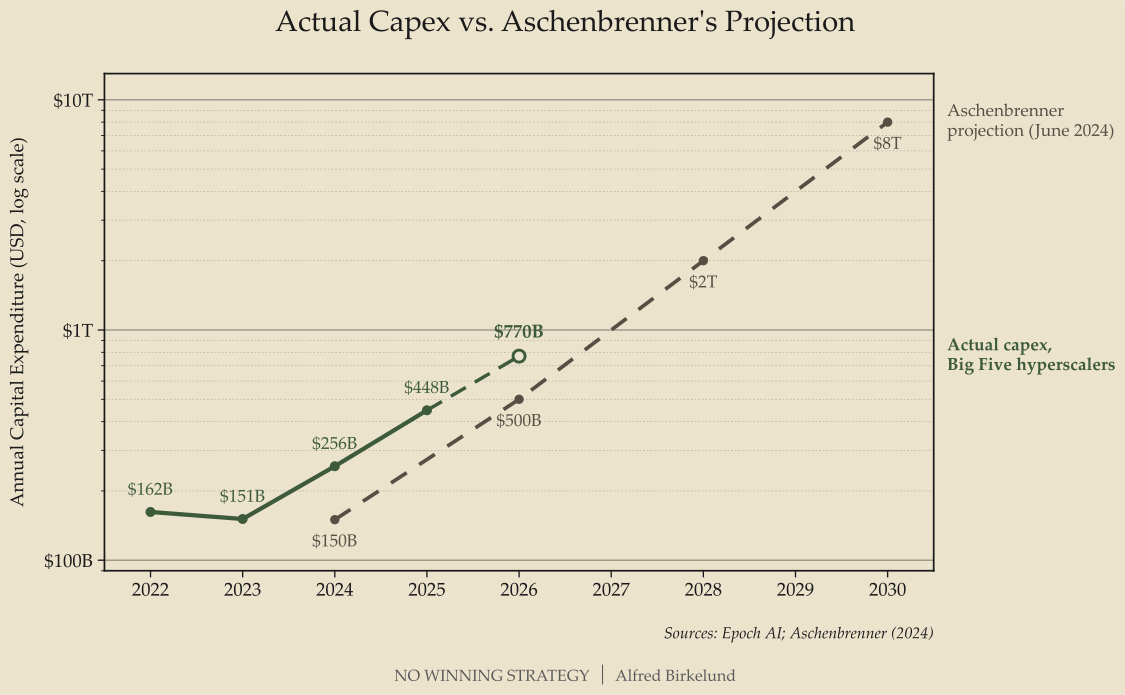
Aschenbrenner’s scaling trajectory is real, and we are running ahead of his projections on both capex† and energy.1 But the argument is not about the numbers. It is about who controls the factors of production.
Frontier model training runs through roughly four labs: OpenAI, Anthropic, Google DeepMind and Meta. The accelerators are dominated by NVIDIA. China runs Huawei’s Ascend stack on SMIC’s trailing nodes†, but leading-edge fabrication has exactly one source: TSMC.2 In the supporting layer, talent agglomerates in the Bay Area, where top researchers command eight- and nine-figure compensation.3
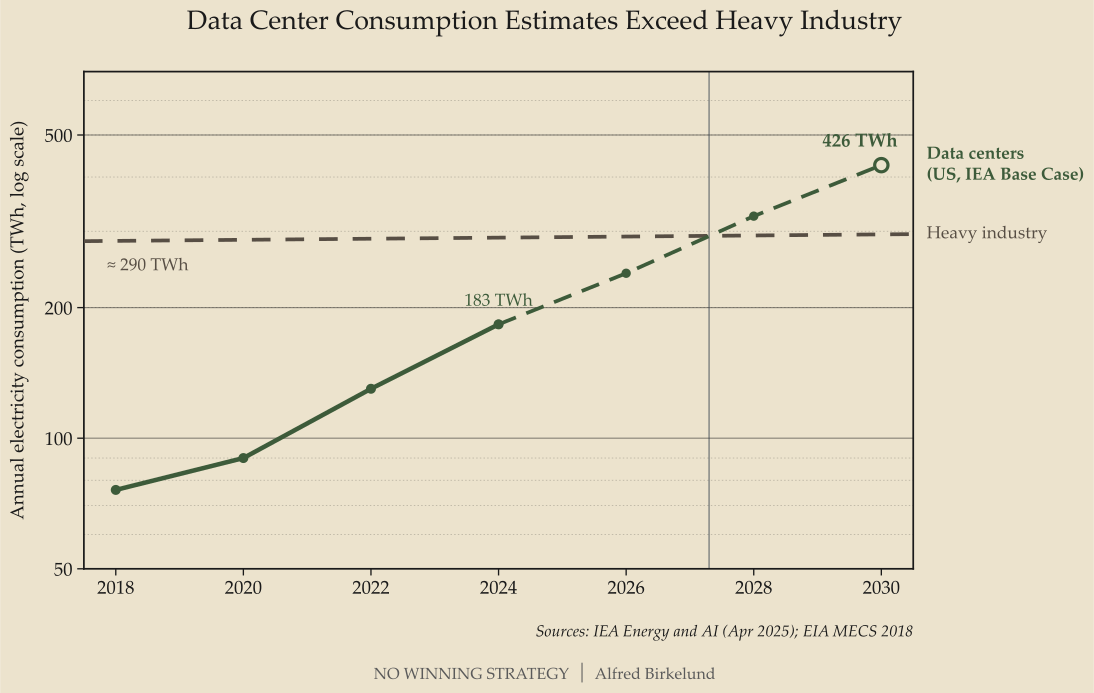
The pressure to scale tightens the bottlenecks. Chips are the obvious one; power, grid, and permitting are worse. In 2027, US data centers are projected to consume more electricity than aluminum, steel, cement, and chemicals combined.4
The standard objection is diffusion. Llama, DeepSeek-R1, Qwen: open-weight models† within months of frontier capability.5 Months. But in an accelerated world, months may as well be years. The premium tracks the frontier, not the diffusion. If anyone with a few hundred GPUs can run near-frontier inference, the four-lab oligopoly is a moat that erodes in quarters. This is correct, and it is the wrong conclusion. Capability diffusing reveals where the moat sits. Models commoditize; their substrate† does not. The compute they were trained on, the energy that powers inference at scale, the robotics that lets them act on the physical world: these are what the frontier labs and host states race to lock down, because they do not diffuse. An open-weight model is a free Ferrari in a country with no roads and no fuel. The post-training value capture migrates to whoever owns the substrate, and the substrate is owned by an overlapping short list as before. Diffusion is no counterargument to the thesis. It is the mechanism that makes the thesis more severe.
The residual list is short. Commodity endowments you happen to sit on. Regulatory and tax arbitrage, a zero-sum game between countries. Place-bound culture: live performance, sport, the residue of things intelligence cannot substitute. Legacy institutional capital. None of these are development ladders. They are landlord rents on assets that lie under your sovereign feet.
Convergence theory predicts otherwise. Poor countries grow faster because capital has higher marginal returns and technology diffuses. AI inverts both. Returns to compute are increasing, and frontier absorption capacity itself exhibits increasing returns.6 The countries that can permit gigawatt clusters and scale national grids are already at the frontier. The gap widens on production and deployment.
The Solow model and Convergence theory
The proposition is drawn from Robert Solow’s 1956 growth model: a production function with diminishing returns to capital, a constant savings rate, and labour growth, which together imply that capital accumulation alone cannot sustain growth. Beyond a steady-state level, each additional unit of capital adds less output, so growth has to come from technology. Convergence is the corollary: a poor country, far below its steady state, has high marginal returns to capital and grows faster than a rich one near its own steady state. Conditional convergence (Barro and Sala-i-Martin, 1992) extends the result to countries with different structural characteristics, so long as you condition on those differences.
Comparative advantage does not save you either. Studwell on East Asian industrialization is specific: land reform funded smallholder agriculture, which generated savings that funded export-disciplined manufacturing, which climbed the ladder under labor-cost arbitrage.7 Each rung was crossable because the rich-country lead on the next rung was finite, and cheap labor financed the climb. AI compresses every rich-country rung simultaneously and substitutes for the labor whose cheapness was the arbitrage. Heckscher-Ohlin makes it worse: when capital substitutes for the abundant factor in a poor country, that factor stops generating an export surplus at all.8 The ladder is not blocked. It is gone.
Heckscher–Ohlin
Eli Heckscher (1919) and Bertil Ohlin (1933): Countries export goods that intensively use the factor of production (capital, labour, land) they have in relative abundance. Wage equalisation (Stolper–Samuelson) follows as a corollary. Invoked here in its corner-solution form: when capital becomes a substitute for cheap labour rather than a complement to it, a labour-abundant country’s labour stops generating any export surplus at all. The standard result (rich country sells the capital-intensive good, poor country sells the labour-intensive one) collapses into “poor country has nothing to export, because the labour-intensive good is now produced by capital.”
The main rent on offer is hosting. Stargate UAE† is the template: a 1GW cluster inside a 5GW campus, traded for alignment with American AI policy and capital flowing back into the American system.9 These look like the financial-center plays Singapore and Dubai compounded into institutional position over forty years. They are not. Financial hosting accumulated capital, regulatory expertise, and institutional density in the host. AI hosting accumulates none of it. Model weights, research talent, and the feedback loops from deployment stay with the buyer. A 5GW Gulf cluster, after forty years, will still be a 5GW Gulf cluster, replaced on the buyer’s depreciation clock†.
Smaller rents on shorter clocks: sovereign data hosting under EU regulation, domain insertion† e.g. Novo Nordisk in drug discovery and public-sector adoption arbitrage. None of it is a ladder. Key-system insertion† exists in principle but is closed to most nations in practice. Assembling a Taiwan, Korea, or Netherlands position is technically open and practically closed. Those positions were earned in a slower world.
Take Denmark. With no frontier insertion, what remains is labor-market absorption: recycling workers from exposed sectors such as business intelligence into sectors AI does not yet touch. Call this the Baumol window. Productivity in AI-touched sectors explodes. Wages in human-delivered services rise because the labor cannot be substituted. Whether Denmark’s reallocation infrastructure can keep pace is the open question.10
Baumol's cost disease and the ‘Baumol window’
William Baumol observed in 1966 that wages in sectors with stagnant productivity (live music, teaching, nursing) rise in line with wages in productive sectors, because workers can move between them. The result, known as cost disease, is that the stagnant sectors take an ever-larger share of GDP. The “Baumol window” used in this essay is the period in which AI raises productivity in cognitive sectors but prior to wide-scale deployment of robotics in the physical-economy.
The window closes when robotics catches the physical economy, when the binding constraint stops being software intelligence and becomes embodied intelligence† acting on atoms. What is on the other side I do not yet know, and I am suspicious of anyone who claims they do.
The Danish self-image of a small open economy that punches above its weight is over. What remains is a high-functioning specialist node in a system we do not shape. That is a real loss of sovereignty; calling it resilience avoids the loss.
The thesis is falsifiable on two counts. Globally: a country outside the current frontier trains at frontier scale within a decade without sourcing compute, talent, or fabrication from the oligopoly. For Denmark: a non-frontier country captures double-digit share of AI productivity gains within a decade without hosting frontier compute.
The substrate is being locked down now, and the failure mode for everyone outside the frontier is assuming the window is longer than it is. The deeper failure is assuming AI is a productivity technology like any other, when it is altering the intelligence those structures run on. By the time most leaders see this, the structures will be gone.
Glossary
Spending on long-lived productive assets: buildings, machinery, data centres. Distinct from operating expenditure (salaries, electricity, supplies). The capex numbers in this essay refer specifically to AI infrastructure spending by the hyperscalers: Amazon (AWS), Microsoft (Azure), Google (Cloud), Meta, and Oracle.
↩In semiconductor manufacturing, a node is a generation of process technology, conventionally labelled by transistor size (3 nm, 5 nm, 7 nm). Leading-edge nodes are the smallest currently in production: 3 nm and 2 nm in 2026, made almost exclusively by TSMC. Trailing nodes are older generations (7 nm and above), where SMIC, Samsung, and others can compete.
↩A model whose trained parameters (“weights”) are publicly downloadable, so anyone with sufficient compute can run it. Distinct from open-source: the training code and data may not be released. Llama, DeepSeek-R1, and Qwen are the leading current examples.
↩Used in this essay as an umbrella term for everything underneath a model: the chips, the data centres, the power grid, the cooling, the networking, and increasingly the robotics. The central claim is that capability diffuses but the substrate does not.
↩OpenAI’s first international deployment of its Stargate AI-infrastructure programme, announced in May 2025: a 1 GW compute cluster inside a 5 GW UAE–US AI Campus across roughly ten square miles in Abu Dhabi, with G42, Oracle, NVIDIA, Cisco, and SoftBank as partners. A gigawatt (GW) is one thousand megawatts; a single nuclear reactor is roughly 1 GW; Denmark’s peak electricity demand is roughly 6 GW.
↩The accounting schedule over which an asset’s cost is written down. Frontier AI hardware depreciates in roughly 4–6 years because newer chips obsolete it. The point here is that a Gulf compute campus does not compound into a strategic asset the way a financial centre does. It just gets replaced.
↩Capturing value by combining frontier AI with domain-specific data, expertise, or distribution that the frontier labs do not have. Novo Nordisk’s drug-discovery position is the example given: proprietary biological data and clinical pipelines that GPT-class systems cannot replicate alone.
↩Occupying an irreplaceable bottleneck in the AI stack: Taiwan in fabrication (TSMC), the Netherlands in lithography (ASML), Korea in memory (HBM). These positions confer genuine leverage but, as the essay argues, are practically closed to new entrants.
↩AI that controls physical actuators (robots, vehicles, machines) rather than just producing text or images. The closing of the Baumol window arrives at the point where embodied intelligence becomes capable enough to substitute for physical-economy labour.
↩Footnotes
-
Leopold Aschenbrenner, Situational Awareness: The Decade Ahead, June 2024 — the original capex/energy projections (≈$500B/yr by 2026, ~$8T/yr by 2030). Big Five hyperscaler capex is now projected at roughly $602B in 2026 alone, ahead of trajectory. See also McKinsey, “The cost of compute: A $7 trillion race to scale data centers”, April 2025. ↩
-
TSMC’s market share at the 3 nm and 2 nm leading-edge nodes is “upwards of 90%”: Daniel Nenni, “TSMC 2025 Update: Riding the AI Wave Amid Global Expansion,” SemiWiki, September 2025; see also Trefis, “TSMC Stock: In the AI Arms Race, the Foundry Wins,” January 2026. On Huawei’s Ascend stack at SMIC: Dylan Patel et al., “Huawei Ascend Production Ramp,” SemiAnalysis, September 2025. SMIC remains stuck at 7 nm because ASML’s EUV lithography is export-controlled — Council on Foreign Relations, “China’s AI Chip Deficit: Why Huawei Can’t Catch Nvidia,” December 2025. ↩
-
M.G. Siegler, “$100M AI Signing Bonuses,” Spyglass, July 2025; Fortune, “Mark Zuckerberg is determined to build an AI superteam,” July 2025. Meta packages have reached $300M over four years with first-year compensation above $100M, with a $1.5B package reportedly offered to (and initially declined by) Andrew Tulloch. ↩
-
International Energy Agency, Energy and AI, Executive Summary, April 2025: “By the end of the decade, the country [US] is set to consume more electricity for data centres than for the production of aluminium, steel, cement, chemicals and all other energy-intensive goods combined.” On the IEA Base Case trajectory (76 TWh in 2018, 183 TWh in 2024, 426 TWh in 2030), data-center consumption crosses the roughly flat heavy-industry total (~290 TWh) around 2027 — the year used in the body. ↩
-
Epoch AI, “Open-weight models lag state-of-the-art by around 3 months on average,” October 2025, using the Epoch Capability Index. DeepSeek-R1 itself: DeepSeek-AI, “DeepSeek-R1: Incentivizing Reasoning Capability in LLMs via Reinforcement Learning,” arXiv preprint, January 2025. ↩
-
Robert M. Solow, “A Contribution to the Theory of Economic Growth,” Quarterly Journal of Economics 70, no. 1 (1956): 65–94; Robert J. Barro and Xavier Sala-i-Martin, “Convergence,” Journal of Political Economy 100, no. 2 (1992): 223–251. ↩
-
Joe Studwell, How Asia Works: Success and Failure in the World’s Most Dynamic Region (Grove Press, 2013). ↩
-
Eli Heckscher and Bertil Ohlin, Heckscher–Ohlin Trade Theory, ed. Flam and Flanders (MIT Press, 1991), originally 1919 and 1933. For a modern textbook treatment: Paul Krugman, Maurice Obstfeld, and Marc Melitz, International Economics: Theory and Policy, 12th ed. (Pearson). ↩
-
OpenAI, “Introducing Stargate UAE,” May 2025; G42, “Global Tech Alliance Launches Stargate UAE,” May 2025. The 1 GW cluster sits within a 5 GW UAE–US AI Campus across roughly ten square miles in Abu Dhabi, with dollar-for-dollar UAE-to-US reinvestment built into the deal. ↩
-
William J. Baumol and William G. Bowen, Performing Arts: The Economic Dilemma (Twentieth Century Fund, 1966); William J. Baumol, “Macroeconomics of Unbalanced Growth: The Anatomy of Urban Crisis,” American Economic Review 57, no. 3 (1967): 415–426. ↩